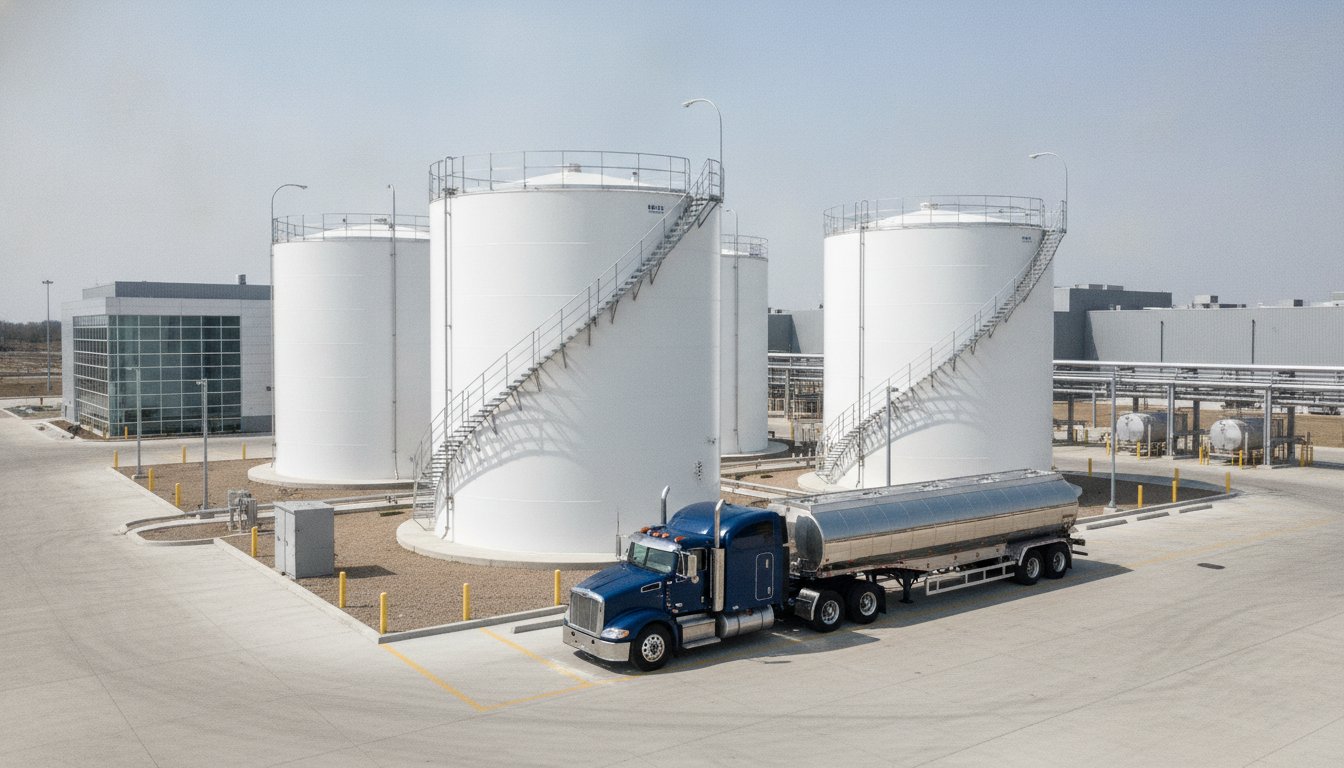
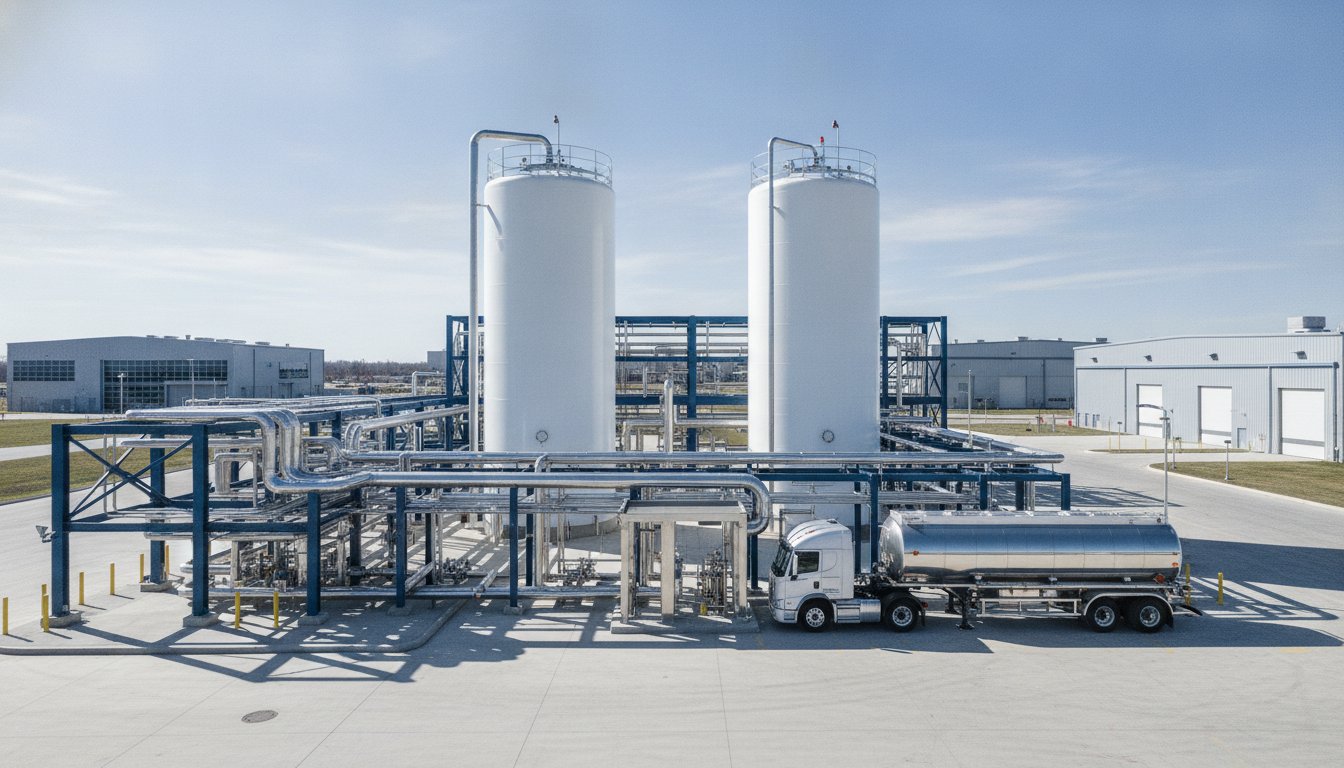
A single failure in your industrial gas supply chain isn't a logistical delay; it's a full-scale operational shutdown that compromises your facility's integrity. Current data shows the Producer Price Index for industrial gas manufacturing reached 735.935 in May 2026. Enterprise procurement now requires more than a standard vendor agreement. Industrial gas supply contracts must transition from simple commodity purchasing to strategic energy infrastructure partnerships that prioritize zero-downtime redundancy. We understand the pressure of managing high-stakes logistics where failure isn't an option.
You likely recognize that supply chain volatility and complex regulatory shifts, such as the April 2026 EPA updates to emission standards, create significant operational risks. Master these complexities to ensure your gas supply remains secure and predictable. This guide provides the technical framework to eliminate hidden delivery costs and maintain strict compliance with DOT and FERC standards. Examine essential service level agreements and transparent pricing models designed to transform your procurement process into a resilient backbone for mission-critical operations.
Key Takeaways
- Classify industrial gas supply contracts as strategic energy infrastructure to move beyond basic commodity procurement.
- Analyze pricing structures and commitment terms to maintain cost predictability in volatile markets.
- Prioritize supply chain security by incorporating multi-site sourcing and strategic reserves into your legal framework.
- Evaluate distributors based on national scale and their ability to manage EPA and DOT compliance requirements.
- Coordinate with a logistics architect to build tailored gas programs that support mission-critical healthcare and manufacturing operations.
Defining Industrial Gas Supply Contracts for High-Stakes Operations
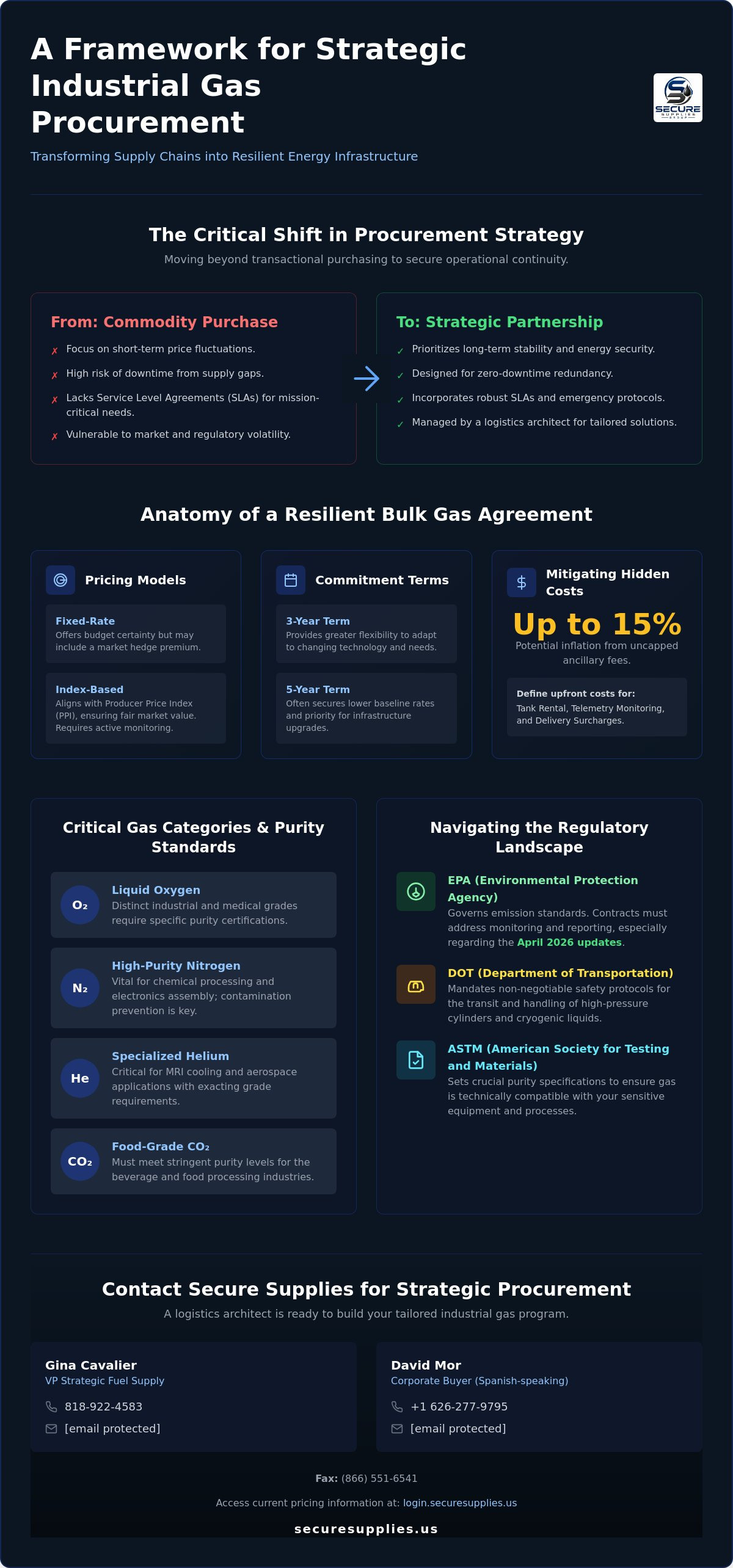
Industrial gas supply contracts represent more than a standard vendor agreement. They are legally binding frameworks designed to ensure the continuous delivery of Industrial gases essential for high-stakes manufacturing, healthcare, and energy production. Standard retail gas agreements often fail industrial requirements because they lack the necessary service level agreements (SLAs) to prevent catastrophic downtime. Procurement officers, facility managers, and logistics architects must prioritize long-term stability over short-term price fluctuations. It's a matter of operational survival in a volatile market where supply chain gaps lead to immediate failure.
A mission-critical mindset is required when drafting these documents. Failure isn't an option for facilities that rely on bulk gas for operational continuity. These contracts define the scope of supply, delivery frequency, and the emergency response protocols necessary to maintain 24/7 production cycles. High-volume buyers need a partner who acts as a logistics architect. This role involves managing the minute details of delivery while maintaining a focus on the big picture of energy security. Logistics architects bridge the gap between procurement goals and operational realities, ensuring every clause translates to a reliable physical delivery for multi-site operations.
Critical Gas Categories in Industrial Agreements
Specific gas grades must be clearly defined within your contract to avoid operational failure. Industrial and medical-grade liquid oxygen (O2) serve distinct roles, each requiring specific purity certifications. High-purity nitrogen (N2) is vital for chemical processing and electronics assembly where even minor contamination can ruin entire batches. Specialized helium is critical for MRI cooling and aerospace applications, while food-grade CO2 must meet stringent purity levels for the beverage and processing industries. Our industrial gas programs ensure these critical materials are delivered to exact ASTM standards, providing the stability needed for long-term project planning.
Regulatory Compliance Standards (EPA, DOT, ASTM)
Operational security depends on meeting strict federal and industry standards. ASTM purity specifications ensure that the gases you receive are technically compatible with your equipment. The Department of Transportation (DOT) mandates rigorous safety protocols for the transit and handling of high-pressure cylinders and bulk cryogenic liquids. Compliance is non-negotiable. In April 2026, the EPA finalized technical changes to emission standards for facilities handling associated gas. Your contract should explicitly outline monitoring provisions and reporting responsibilities to mitigate regulatory risks and avoid heavy fines. Meticulous planning in the contracting phase prevents legal and environmental liabilities later.
Contact Secure Supplies Group for Strategic Procurement:
Gina Cavalier, VP Strategic Fuel Supply: 818-922-4583 | [email protected]
David Mor, Corporate Buyer (Spanish-speaking): +1 626-277-9795 | [email protected]
Fax: (866) 551-6541
Log in at login.securesupplies.us to access current pricing information. Visit us at securesupplies.us to learn more about our comprehensive energy solutions.
Essential Structural Components of Bulk Gas Agreements
Effective industrial gas supply contracts serve as the blueprint for operational continuity. Procurement professionals must choose between fixed-rate and index-based pricing strategies. Fixed rates offer budget certainty but often include a premium to hedge against market volatility. Index-based models align with the Producer Price Index (PPI), which sat at 735.935 in May 2026. This alignment ensures you aren't overpaying when production costs drop; however, it requires active monitoring of market shifts. Term length is another critical lever. A three-year commitment provides flexibility to pivot as technology changes. Conversely, five-year terms often secure lower baseline rates and priority infrastructure upgrades.
Identifying hidden costs is a priority for any logistics architect. Ancillary fees for tank rental, telemetry monitoring, and delivery surcharges can inflate total expenditures by 15% if not capped. Ensure your agreement defines these costs upfront. It's also vital to align your contract with Federal sustainable procurement policies to maintain compliance with federal supply chain resilience standards. This level of meticulous planning prevents budget creep and ensures your facility remains competitive in a tightening market.
Volume Commitments and Take-or-Pay Logic
Take-or-Pay clauses require precise baseline calculations. If you over-commit, you pay for unused product. If you under-commit, you risk shortages during peak demand. Negotiate "Force Majeure" clauses that specifically cover industrial interruptions like power grid failures or regulatory shutdowns. This protection is essential for maintaining financial stability during unforeseen downtime. Consider a tiered volume approach to scale supply for seasonal spikes without triggering penalties. If your current agreement lacks these safeguards, it's time to request a strategic contract review.
Delivery and Logistics SLAs
Specify clear delivery windows for bulk liquid oxygen, nitrogen, and CO2. Vague timelines lead to operational bottlenecks. Your contract should dictate emergency response times for unexpected depletion. This ensures a truck arrives before your reserve hits critical levels. Integrating these requirements with your bulk fuel delivery services creates a unified logistics strategy. Establishing these Service Level Agreements (SLAs) transforms a vendor into a true logistics partner. It's about securing the backbone of your daily functions through foresight and redundancy.
Contact Secure Supplies Group for Strategic Procurement:
Gina Cavalier, VP Strategic Fuel Supply: 818-922-4583 | [email protected]
David Mor, Corporate Buyer (Spanish-speaking): +1 626-277-9795 | [email protected]
Fax: (866) 551-6541
Log in at login.securesupplies.us to access current pricing information. Visit us at securesupplies.us to learn more about our comprehensive energy solutions.
Risk Management: Ensuring Supply Chain Security
Single-source reliance is a critical liability in industrial procurement. Your industrial gas supply contracts must mandate multi-site sourcing to prevent total operational collapse. If a primary production facility fails, the legal framework must trigger an immediate shift to secondary or tertiary nodes within the distributor's network. This level of foresight protects your bottom line from regional outages and infrastructure failures. Building these redundancy protocols into the contract ensures that your facility remains operational while competitors face shutdowns. Strategic reserves are equally vital. Maintaining high-capacity on-site storage provides a necessary buffer against market spikes and temporary distribution bottlenecks.
Priority delivery clauses are the only defense against the ongoing global helium shortage. Technical applications in aerospace and healthcare can't afford supply interruptions. Your contract should dictate that your facility receives allocation priority over non-critical commercial accounts during shortages. Additionally, ensure all agreements specify compliance with medical-grade standards for liquid oxygen. This involves adhering to strict purity requirements and DOT transport safety protocols. Meticulous planning here prevents the introduction of contaminants that could damage equipment or compromise safety. We treat every delivery as a mission-critical event where precision is the only acceptable outcome.
Mission-Critical Redundancy Protocols
Contractual guarantees must prioritize your facility during national emergencies or regional infrastructure crises. Standard delivery schedules aren't enough when the market tightens. Establishing secondary backup systems and increasing on-site storage capacity reduces your vulnerability to external shocks. For a deeper look at protecting your operations, consult our Industrial Gas Supply Chain Security Pillar. These protocols ensure continuity when the broader market falters. You need a partner who understands the gravity of downtime and plans for every contingency.
Quality Assurance and Purity Verification
Verify every delivery against technical specifications before it enters your system. Demand on-site testing for medical-grade nitrogen and oxygen to confirm purity levels meet ASTM standards. Food-grade CO2 requires rigorous chain of custody documentation to prevent contamination in the processing line. Sourcing from verified high purity helium suppliers ensures your specialized equipment operates within intended parameters. Consistent testing protocols eliminate the risk of substandard product. Don't leave your equipment's integrity to chance; mandate verification in the contract.
Contact Secure Supplies Group for Strategic Procurement:
Gina Cavalier, VP Strategic Fuel Supply: 818-922-4583 | [email protected]
David Mor, Corporate Buyer (Spanish-speaking): +1 626-277-9795 | [email protected]
Fax: (866) 551-6541
Log in at login.securesupplies.us to access current pricing information. Visit us at securesupplies.us to learn more about our comprehensive energy solutions.
Evaluation Framework for Selecting a National Distributor
Scale is the ultimate safeguard for multi-site industrial operations. While regional providers might offer competitive local pricing, they often lack the redundancy required to maintain industrial gas supply contracts during widespread infrastructure failures. National distributors provide a critical buffer by leveraging a broader network of production nodes and logistics hubs. This scale ensures that a disruption in one region doesn't lead to a total supply chain collapse at your facility. Selecting a partner with national reach means you're investing in a logistics architect capable of managing complex, cross-border energy requirements with unwavering reliability.
Logistics integrity extends beyond simple delivery. You must vet the provider’s fleet capacity and safety record to ensure they can meet high-volume demands without compromising standards. Digital integration is now a mandatory requirement for enterprise procurement. Real-time pricing and inventory portals allow facility managers to monitor consumption and costs with precision. Accessing current data through a secure portal, such as our pricing dashboard, eliminates the guesswork in budgeting and replenishment. If your current provider relies on manual reporting, you're exposed to unnecessary operational risks and hidden inefficiencies. It's time to request a quote for a digitally integrated gas program.
Infrastructure and Monitoring Technology
Automated tank monitoring is no longer optional for high-stakes facilities. Your contract should mandate telemetry solutions that provide real-time visibility into gas levels to prevent costly run-outs. This technology allows for proactive replenishment based on actual consumption patterns rather than estimated schedules. Integrating these systems with your existing energy infrastructure projects creates a streamlined operational environment. Customized telemetry is especially vital for high-volume manufacturing where even a minor drop in pressure can halt production lines and damage sensitive equipment.
The Vetting Checklist for Procurement Officers
Verify every potential partner against a rigorous compliance checklist. This includes reviewing current EPA and DOT certifications to ensure all transport and storage protocols meet federal safety standards. Examine historical SLA performance data to confirm the provider's ability to maintain uptime during market volatility. Additionally, assess their specific expertise in managing high-density power environments, such as data center energy requirements. A partner who understands the precision needed for data centers is well-equipped to handle any mission-critical industrial application.
Contact Secure Supplies Group for Strategic Procurement:
Gina Cavalier, VP Strategic Fuel Supply: 818-922-4583 | [email protected]
David Mor, Corporate Buyer (Spanish-speaking): +1 626-277-9795 | [email protected]
Fax: (866) 551-6541
Log in at login.securesupplies.us to access current pricing information. Visit us at securesupplies.us to learn more about our comprehensive energy solutions.
Strategic Gas Procurement with Secure Supplies Group
Secure Supplies Group functions as a logistics architect for your most demanding infrastructure requirements. We don't just facilitate deliveries; we establish supply chain permanence for facilities where downtime is a non-negotiable failure. Our industrial gas supply contracts are built on a foundation of technical precision and regulatory expertise. We manage the high-stakes details of bulk liquid oxygen, nitrogen, and helium procurement so your facility managers can focus on core operations. Every contract we design prioritizes unwavering reliability and long-term stability in an increasingly volatile energy market.
We provide tailored contracting solutions for high-volume manufacturing and healthcare facilities across the nation. These sectors require a partner who understands the gravity of medical-grade purity and the technical specifications of ASTM standards. Our nationwide delivery network ensures your multi-site operations receive consistent, high-purity product regardless of regional market shifts. We maintain strict adherence to DOT transportation safety protocols and EPA monitoring provisions. This commitment to compliance protects your organization from the regulatory risks and hidden costs that often plague standard retail agreements.
Direct Procurement and Strategic Support
Our consultative approach ensures your procurement strategy aligns with your specific operational scale. We design comprehensive programs for data centers and large-scale trucking fleets that require integrated energy solutions. Transparency is the backbone of our partnership model. We encourage clients to leverage login.securesupplies.us to access real-time market data and transparent pricing. This digital integration allows for precise budgeting and proactive inventory management. For international supply chains, David Mor provides dedicated Spanish-language procurement support to ensure seamless communication and logistical coordination across borders.
Contact Our Strategic Supply Team
Secure Supplies Group is committed to the success of the operations we support. We act as a steady hand in a volatile market, providing the foresight and redundancy necessary for mission-critical functions. Whether you're managing a single high-volume site or a complex national network, our team is prepared to architect a solution that meets your exact technical and logistical requirements. Reach out today to initiate a strategic review of your industrial gas needs.
Secure Supplies Group Contact Information:
Gina Cavalier, VP Strategic Fuel Supply
Phone: 818-922-4583
Email: [email protected]
David Mor, Corporate Buyer (Spanish-Speaking Procurement)
Phone: +1 626-277-9795
Email: [email protected]
Fax: (866) 551-6541
Access current pricing information: login.securesupplies.us
Official Website: securesupplies.us
Securing Your Operational Future Through Strategic Contracting
Transitioning from simple commodity purchasing to a strategic partnership is the only way to safeguard mission-critical facilities. Effective industrial gas supply contracts must prioritize zero-downtime redundancy and strict adherence to ASTM and DOT standards. By integrating real-time telemetry and transparent pricing models, procurement officers can eliminate hidden costs and maintain supply chain security even in volatile markets. Scaling your operations requires a logistics architect who understands the gravity of industrial downtime. It's about preparedness and foresight.
Secure Supplies Group provides the technical expertise and national reach necessary for high-stakes energy infrastructure. Our team, led by Gina Cavalier, VP of Strategic Fuel Supply, manages specialized energy programs for Data Centers and Super Yachts alongside a comprehensive logistics network for bulk O2, N2, and CO2. We offer the stability your infrastructure demands. Don't leave your continuity to chance. Contact our team for strategic industrial gas procurement and contract management to ensure your operations remain resilient and compliant. We are ready to support your mission-critical goals.
Secure Supplies Group Contact Information:
Gina Cavalier, VP Strategic Fuel Supply: 818-922-4583 | [email protected]
David Mor, Corporate Buyer (Spanish-speaking): +1 626-277-9795 | [email protected]
Fax: (866) 551-6541
Log in at login.securesupplies.us to access current pricing information. Visit securesupplies.us to secure your supply chain today.
Frequently Asked Questions
What are the typical durations for industrial gas supply contracts?
Typical durations for industrial gas supply contracts range from three to five years. A three-year term provides the flexibility needed to pivot during technological shifts or market changes. Five-year commitments often secure more favorable baseline pricing and priority for infrastructure projects. Procurement officers must evaluate their long-term operational stability when selecting a term length to ensure continuous supply chain security.
How do Take-or-Pay clauses impact manufacturing overhead?
Take-or-Pay clauses mandate payment for a minimum gas volume regardless of actual usage. This creates a fixed overhead cost that can strain budgets during production slowdowns. Meticulous baseline consumption modeling is required to prevent paying for unused product. These clauses are designed to guarantee that the distributor maintains the necessary infrastructure and fleet capacity to support your facility's mission-critical demands.
What is the difference between medical-grade and industrial-grade gas contracts?
Medical-grade contracts require gases to meet strict ASTM and FDA purity standards for patient safety. These agreements include rigorous chain-of-custody documentation and specialized handling protocols. Industrial-grade contracts focus on manufacturing purity levels for processes like chemical blanketing or electronics assembly. While both require precision, medical-grade gases are subject to additional regulatory oversight to ensure they are safe for clinical and physiological use.
How does nationwide distribution improve supply chain security for multi-site firms?
Nationwide distribution enhances supply chain security by providing a redundant network of production nodes. If a localized infrastructure failure occurs, a national provider can reroute supply from other regions to prevent downtime. This scale is vital for multi-site firms that require consistent service levels across diverse geographic locations. It ensures that your entire operation remains resilient against regional market volatility or logistics bottlenecks.
Can gas supply contracts include provisions for emergency fuel delivery?
Yes, strategic gas contracts can incorporate provisions for emergency fuel delivery to ensure total operational resilience. This is especially critical for data centers that require both industrial gases and backup power fuel. Secure Supplies Group designs integrated programs that cover bulk fuel and gas requirements under a single logistics framework. This unified approach eliminates the risk of coordinating multiple vendors during a high-stakes emergency response.
What regulatory bodies oversee the transport and storage of industrial gases?
The Department of Transportation (DOT) regulates the physical transit of gases, while the Environmental Protection Agency (EPA) oversees bulk storage and emission standards. In April 2026, the EPA finalized technical changes to monitoring provisions for certain gas facilities. Additionally, the Federal Energy Regulatory Commission (FERC) manages interstate pipeline regulations. Compliance with these agencies ensures your facility avoids legal liabilities and maintains a secure operational status.
How can I access current pricing for bulk nitrogen and oxygen?
Current pricing for bulk nitrogen and oxygen is accessible through our secure digital portal. Market rates are heavily influenced by the Producer Price Index, which reached 735.935 in May 2026. Registered clients should visit login.securesupplies.us to view real-time data and manage their industrial gas supply contracts effectively. This platform provides the transparency needed for accurate enterprise budgeting and forecasting.
What is a "logistics architect" in the context of energy supply?
A logistics architect is a strategic expert who designs and manages comprehensive energy supply chains. They move beyond simple delivery to focus on infrastructure redundancy, regulatory compliance, and long-term security. This role involves seeing the big picture of industrial energy needs while managing the minute details of bulk logistics. For mission-critical facilities, a logistics architect is the essential backbone that prevents downtime and ensures operational continuity.
Secure Supplies Group Contact Information:
Gina Cavalier, VP Strategic Fuel Supply: 818-922-4583 | [email protected]
David Mor, Corporate Buyer (Spanish-speaking): +1 626-277-9795 | [email protected]
Fax: (866) 551-6541
Log in at login.securesupplies.us to access current pricing information. Visit securesupplies.us to secure your supply chain today.
Disclaimer
The information provided in this article is for general informational purposes only and does not constitute professional, legal, safety, or financial advice. Fuel and energy product specifications, pricing, availability, and regulatory requirements vary by location, application, and over time, and may differ from the general information presented here. Secure Supplies makes no warranties regarding the accuracy, completeness, or current applicability of this content. Handling, storage, and use of fuels and industrial gases can be hazardous and should always follow applicable laws, manufacturer guidance, and qualified professional advice. For current specifications, pricing, and tailored supply solutions, please contact Secure Supplies directly.