
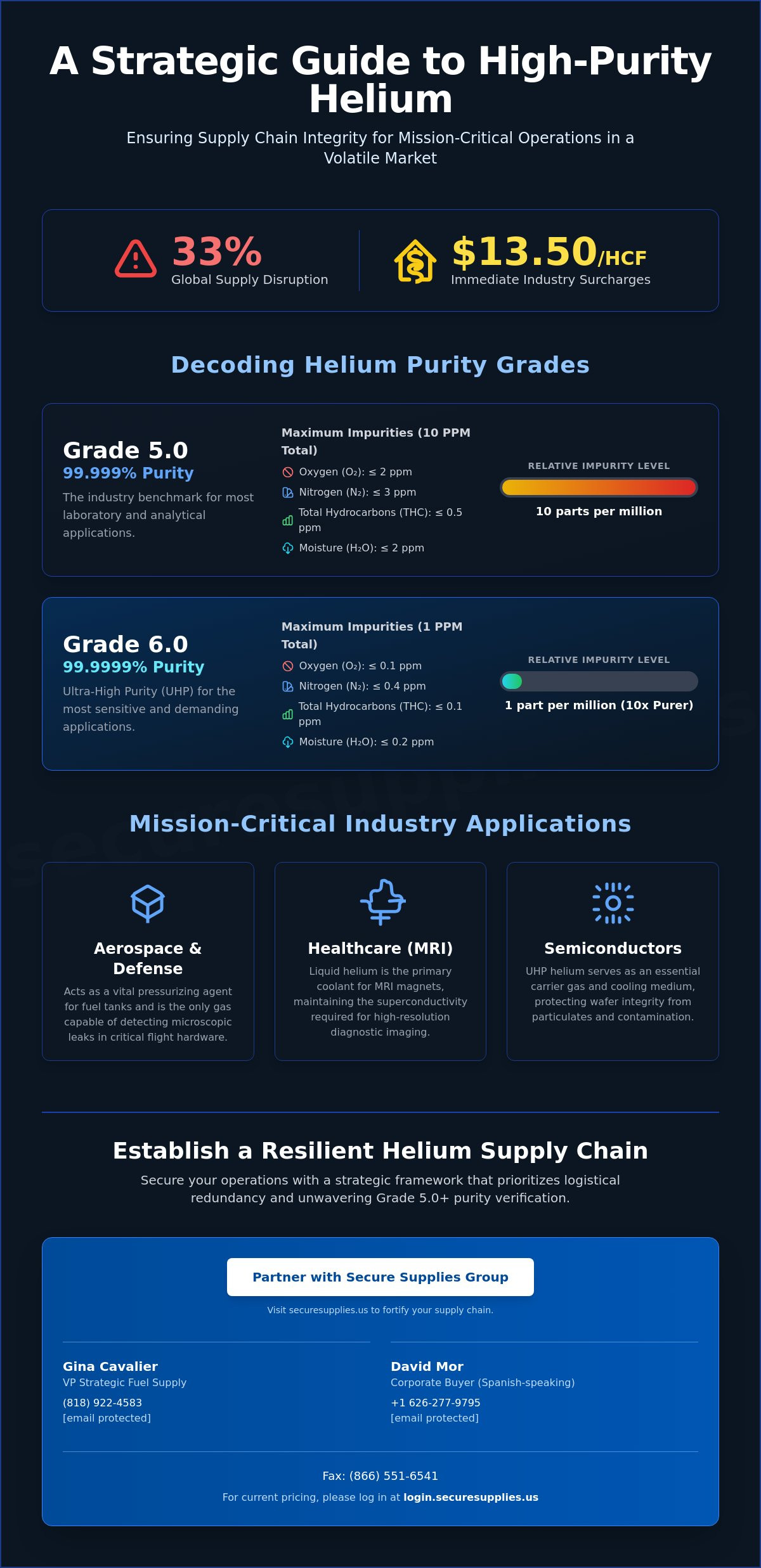
Approximately 33% of the global helium supply disappeared in March 2026 following damage at a major international production facility. This disruption triggered immediate industry-wide surcharges of $13.50 per hundred cubic feet and forced many providers to slash client allocations by half. In this volatile environment, your choice of a high purity helium supplier determines whether your facility maintains its schedule or faces a forced shutdown. You've likely seen the impact of these price spikes and contract cancellations firsthand. Traditional sourcing methods simply fail to protect sensitive equipment and multi-site operations when the market destabilizes.
Securing your mission-critical infrastructure requires a shift from simple procurement to a strategic supply chain framework. This guide outlines how to guarantee gas purity from Grade 5.0 to 6.0 while establishing reliable delivery SLAs that survive global volatility. We'll examine the logistical redundancy necessary to mitigate geopolitical risks and explore the scalable solutions required for complex industrial gas needs. By the end of this article, you'll have a clear roadmap for managing supply chain risks and ensuring your critical systems remain fully operational despite global scarcity.
Key Takeaways
- Differentiate between Grade 4.5 and Grade 6.0 ultra-high purity (UHP) to align gas specifications with sensitive semiconductor and fiber optic requirements.
- Evaluate your high purity helium supplier based on their ability to provide independent Certificates of Analysis (CoA) and maintain significant inventory scale.
- Identify and mitigate "single-point-of-failure" risks in your gas supply chain to maintain operational continuity during global helium shortages.
- Implement specialized logistics protocols for high-pressure cylinders and tube trailers to prevent contamination during the delivery and connection process.
- Establish a strategic procurement framework that prioritizes logistical redundancy and unwavering Grade 5.0+ verification for mission-critical industrial applications.
Understanding High Purity Helium Grades and Industrial Requirements
Industrial operations demand precise gas specifications to maintain equipment integrity. Helium purity is classified by a grade system where the first digit indicates the number of nines and the second digit represents the final decimal. Grade 4.5 signifies 99.995% purity. Grade 6.0 represents 99.9999% ultra-high purity (UHP). Selecting a high purity helium supplier demands an understanding of how these minute differences impact your specific application. In semiconductor manufacturing, trace moisture or hydrocarbons can ruin entire batches of silicon wafers. Fiber optic production also relies on high-purity environments to ensure signal clarity across vast distances. Understanding Helium properties and uses is essential for facility managers who must balance cost with technical necessity.
Grade 5.0 (99.999%) is the benchmark for gas chromatography. It limits total impurities to 10 parts per million (ppm). This precision is necessary to prevent baseline noise in sensitive analytical instruments. Grade 6.0 drops allowable impurities to 1 ppm. This level of control is non-negotiable for research laboratories and advanced quantum computing cooling systems. Oxygen and nitrogen are the primary contaminants to monitor. They cause oxidation and thermal conductivity issues in high-stakes environments. Identifying these risks early prevents equipment failures and data inaccuracies.
Technical Specifications: Grade 5.0 vs. Grade 6.0
Grade 5.0 is the workhorse of industrial laboratories. It maintains a maximum of 2 ppm of oxygen and 3 ppm of nitrogen. These levels are sufficient for most chromatography and spectral analysis. When your project involves deep cryogenics or specialty electronics, Grade 6.0 becomes the requirement. At 99.9999% purity, the presence of hydrocarbons is restricted to 0.1 ppm. This prevents carbon buildup on sensitive components. A high purity helium supplier must provide a Certificate of Analysis (CoA) to verify these concentrations. Common impurities that require monitoring include:
- Oxygen: Causes oxidation in metal components and interferes with spectral readings.
- Nitrogen: Alters thermal conductivity and can lead to inaccurate analytical results.
- Hydrocarbons: Leave deposits on sensitive optical and electronic surfaces.
- Moisture: Leads to ice formation in cryogenic systems and corrosion in gas lines.
Industry-Specific Purity Standards
In aerospace, helium serves as a pressurizing agent for fuel tanks and a medium for leak detection. It's the only gas capable of finding microscopic cracks in critical flight hardware. Healthcare providers require FDA-compliant medical grade helium. Liquid helium is the primary coolant for MRI magnets, maintaining the superconductivity required for high-resolution imaging. Without a steady supply of high-purity liquid helium, MRI machines risk a "quench," which causes immediate downtime and potential magnet damage. Semiconductor fabrication facilities use UHP helium as a carrier gas and a cooling medium. Protecting wafer integrity requires a total absence of particulates. Every step of the supply chain must focus on maintaining these rigorous standards to ensure operational continuity.
While industrial and medical sectors focus on large-scale gas purity, similar principles are being applied to personal health through molecular hydrogen systems. If you are interested in how high-purity hydrogen can support daily wellness, learn more about the latest home-use generation technology.
Evaluating a High Purity Helium Supplier: Key Selection Criteria
Selecting a high purity helium supplier is a critical decision that impacts operational security and long-term cost management. Reliance on spot-market availability is no longer a viable strategy for industrial facilities. According to Helium production and consumption data, global supply remains highly concentrated. This concentration makes procurement vulnerable to regional disruptions and sudden price spikes. Facility managers must look beyond basic price points. They must evaluate a supplier’s logistical infrastructure and their ability to maintain purity standards under extreme market pressure. Operational continuity depends on these factors.
Quality Assurance and Certification
Purity is not a static attribute. It requires constant verification. Demand batch-specific Certificates of Analysis (CoA) for every delivery. A CoA confirms that the gas meets specific ISO 14175 standards for welding and industrial processes. Traceability is equally critical. You need to know the origin of your gas and every point of contact it had during transport. Reliable suppliers maintain in-house laboratory capabilities. This allows for real-time verification before the product leaves the facility. It eliminates the risk of contaminated cylinders reaching your sensitive equipment. Verification is the only way to ensure Grade 5.0 or 6.0 integrity.
Strategic Procurement Frameworks
Supply chain resilience depends on the supplier’s business model. Direct supply models often provide better security than third-party distributors during global shortages. Consider the supplier’s historical performance during crisis periods. For instance, in March 2026, many providers were forced to limit client allocations to 50% of normal volumes due to international plant outages. A robust high purity helium supplier should have strategic reserve management protocols in place. This includes long-term contract security that prioritizes mission-critical operations over spot-market sales. It's about securing a "logistics architect" rather than just a vendor.
Technical expertise is the final pillar of evaluation. Does the supplier understand your system integration needs? High-volume demands require specialized handling, such as tube trailers or high-pressure cylinders. Verify their emergency response capabilities and technical support for gas handling. If a leak occurs or a system requires immediate purging, your supplier must act with the precision of a seasoned logistics partner. They should provide the foresight needed to avoid downtime. This level of partnership ensures that your critical infrastructure remains protected regardless of market volatility. High-stakes operations leave no room for error.
Supply Chain Security: Mitigating Global Helium Shortages
The global helium market entered a period of extreme volatility in early 2026. Damage at Qatar's Ras Laffan facility in March 2026 removed approximately one-third of the world's supply from the market. Repairs are projected to take three to five years. This event underscores the fragility of relying on a single high purity helium supplier without a diversified logistical backbone. Industrial operations must now account for spot prices that surged between 40% and 100% following the disruption. Effective procurement requires identifying "single-point-of-failure" risks within your existing framework. If your provider relies on a centralized hub or a single international source, your facility is vulnerable to the 50% allocation cuts seen across North America this year.
Data from the U.S. Geological Survey Mineral Commodity Summary highlights the shifting landscape of Grade-A helium production. Since the privatization of the U.S. Federal Helium Reserve in 2024, the buffer against international supply shocks has diminished. Top-tier suppliers now manage their own strategic reserves to protect long-term partners. These buffer stocks are the only defense against the $13.50 per hundred cubic feet surcharges that became industry standard on March 17, 2026. Secure sourcing involves a "logistics architect" approach that prioritizes national delivery stability through multi-layered inventory management.
Redundancy and Continuity Planning
Multi-source procurement is no longer optional. It's a requirement for operational survival. Geopolitical factors in Qatar and Russia continue to dictate availability, making North American production more critical than ever. Recent regulatory shifts, such as the May 2026 Minnesota law governing helium development, show a clear trend toward domestic resource securing. Your 2026-ready contingency plan should include secondary supply lines and verified backup storage. Redundancy ensures that a regional outage doesn't become a total facility shutdown.
Contractual Security and Scalability
Traditional gas contracts often fail during force majeure events. You need structured agreements that provide volume guarantees and price stability even during scarcity. Scalable delivery models are essential for multi-site industrial operations. They allow for the redistribution of inventory based on real-time demand across different facilities. Risk management protocols must be integrated into every procurement step. This ensures that mission-critical facilities receive priority during allocation periods. Secure your operations by partnering with a high purity helium supplier that treats supply chain security as a strategic imperative. Foresight is the only way to maintain a steady hand in a volatile market.
Logistics and Handling: Ensuring Purity from Production to Use
Maintaining gas integrity from the production facility to the point of use requires a rigorous logistical chain. A high purity helium supplier must deploy specialized transport equipment designed to prevent atmospheric ingress. This includes DOT-certified high-pressure cylinders, cryogenic dewars for liquid applications, and high-capacity tube trailers for industrial-scale consumption. Contamination often occurs during the final connection phase. Even minor exposure to ambient air introduces moisture and oxygen. These contaminants can degrade Grade 6.0 helium to an unusable state for semiconductor manufacturing or fiber optic cooling. Secure your infrastructure by demanding dedicated transport and connection protocols that prioritize purity over delivery speed.
Effective handling protocols extend beyond the delivery vehicle. Dedicated gas manifolds and high-purity regulators are essential components for any mission-critical system. These distribution networks must be purged with inert gas before every connection to clear the dead space of potential contaminants. Using generic equipment for high-purity applications is a high-risk error. It leads to equipment fouling and inconsistent analytical results. Facility directors should prioritize stainless steel manifolds with orbital welds to minimize potential leak paths. Real-time monitoring of pressure and flow rates allows facility managers to detect leaks before they impact production. This proactive approach is the hallmark of a seasoned logistics partner. Monitoring volume prevents the sudden run-outs that cause expensive restarts in sensitive industrial lines.
Delivery Infrastructure and Equipment
Selection of delivery hardware depends entirely on your consumption profile. High-pressure gas cylinders, often meeting DOT-3AA specifications, provide flexibility for intermittent laboratory use. Cryogenic dewars are the industry standard for MRI cooling and deep-freeze applications. For multi-site industrial operations, tube trailers offer the highest volume efficiency. Safety protocols must follow DOT and OSHA standards for the storage of compressed gases. This includes proper ventilation, secure anchoring, and the use of specific CGA fittings to prevent cross-connection. Handling liquid helium requires specialized PPE to prevent cryogenic burns during transfer. Every step must be meticulously planned to ensure operational safety.
Point-of-Use Integrity
The manifold system is the heart of your gas distribution. Regular maintenance and ultrasonic leak detection are non-negotiable. Training personnel on the specific thermal properties of helium prevents handling injuries and gas wastage. Helium's small molecular size allows it to escape through seals that are gas-tight for nitrogen or oxygen. Automated tank monitoring systems provide a critical layer of security. They transmit real-time volume data directly to your logistics partner. This ensures seamless replenishment without the risk of operational downtime. Secure your supply chain today by partnering with a dedicated industrial gas logistics expert.
Secure Supplies Group: Your Partner for Mission-Critical Helium
Secure Supplies Group operates as a logistics architect for the most demanding industrial sectors. We understand that a failure in gas supply isn't just a delay; it's a threat to infrastructure integrity. As a dedicated high purity helium supplier, we maintain a mission-critical mindset that treats your operational continuity as our primary metric of success. Our national scale allows us to buffer the shocks of global supply disruptions, such as the 2026 Qatar plant outage, ensuring that hospitals, data centers, and semiconductor plants remain online. We don't just deliver gas. We secure the backbone of your daily functions through meticulous planning and logistical redundancy.
Technical verification remains the cornerstone of our operations. We maintain an unwavering commitment to Grade 5.0 and 6.0 purity standards. Every shipment undergoes rigorous testing to ensure it meets the specific requirements of your sensitive equipment. This level of precision is vital for data center energy programs and medical facilities where even minor contaminants cause catastrophic failures. We manage the minute details of delivery and compliance so your facility directors can focus on core operations. Our team acts as a steady hand in a volatile market, providing the stability required for long-term industrial success.
Why National Leaders Trust Secure Supplies
National leaders trust our Group because we provide comprehensive energy and gas solutions that go beyond simple delivery. Our portfolio includes bulk fuel delivery, industrial gases, and energy infrastructure projects. This breadth of expertise allows us to see the big picture of your energy supply while managing the technical nuances of high-purity gas logistics. We've built a proven track record in high-volume procurement, acting as the essential backbone for diverse commercial fleets and mission-critical facilities. Our authority in the sector is grounded in reality and backed by a commitment to industry standards like ASTM and DOT.
Initiating Your Helium Supply Program
Initiating your supply program begins with a consultative assessment of your facility’s specific gas requirements. We don't use one-size-fits-all models. Our strategic logistics planners work directly with your procurement managers to develop a scalable delivery framework tailored to your multi-site operations. This process includes a streamlined onboarding sequence that provides direct access to our technical experts. You'll move from a state of supply vulnerability to one of logistical security. Secure your high-purity helium supply with Secure Supplies Group today to stabilize your industrial gas procurement and protect your critical infrastructure.
For strategic supply inquiries and contract management, contact our leadership team:
Gina Cavalier, VP Strategic Fuel Supply
818-922-4583 | [email protected]
David Mor, Corporate Buyer (Spanish-speaking Secure Supplies Group)
+1 626-277-9795 | [email protected]
Fax: (866) 551-6541
Current clients and authorized procurement officers should log in at login.securesupplies.us for real-time pricing and inventory status.
Securing Future Helium Availability
The current global helium shortage demands a shift from reactive purchasing to strategic procurement. You've seen how Grade 5.0 and 6.0 purity levels are non-negotiable for sensitive operations in the semiconductor and medical sectors. Protecting these assets requires specialized handling equipment and real-time monitoring to prevent atmospheric contamination. Selecting a high purity helium supplier with a mission-critical mindset ensures your facility remains operational during supply disruptions. It's the only way to maintain a steady hand in a volatile market.
Secure Supplies Group provides a national distribution network and a comprehensive industrial gas portfolio including O2, N2, CO2, and Helium. We manage the minute details of logistics and compliance so you don't have to face the risks of unplanned downtime. Transitioning to a secure supply framework is the most effective way to stabilize your long-term operational costs. Partner with Secure Supplies Group for Reliable Helium Logistics and fortify your critical infrastructure today.
Gina Cavalier, VP Strategic Fuel Supply
818-922-4583 | [email protected]
David Mor, Corporate Buyer for the Spanish-speaking Secure Supplies Group
+1 626-277-9795 | [email protected]
Fax: (866) 551-6541
Current pricing is available for authorized procurement officers. Please log in at login.securesupplies.us for the latest market rates.
Frequently Asked Questions
What is the difference between Grade 5.0 and Grade 6.0 helium?
Grade 5.0 helium maintains 99.999% purity with a maximum of 10 parts per million (ppm) of total impurities. Grade 6.0 increases this to 99.9999% purity, limiting impurities to just 1 ppm. While Grade 5.0 is the industrial standard for gas chromatography, Grade 6.0 is non-negotiable for ultra-sensitive semiconductor manufacturing and quantum research. Choosing the correct grade prevents baseline noise in analytical instruments and protects delicate components from oxidation.
How does a high purity helium supplier verify gas quality?
A high purity helium supplier verifies gas quality through batch-specific Certificates of Analysis (CoA) and rigorous laboratory testing. These tests measure precise levels of oxygen, nitrogen, moisture, and hydrocarbons. Trusted providers maintain full traceability from the production source to the point of delivery. This ensures that every cylinder or dewar meets the specified grade. Verification protocols are the only defense against contaminants that could compromise sensitive industrial processes or medical equipment.
Can I get medical grade helium delivered for clinical applications?
Medical grade helium is available for clinical applications including MRI cooling and respiratory therapy. These products must strictly adhere to FDA regulations for medical gases. Secure Supplies Group provides medical-grade helium alongside O2, N2, and CO2 for healthcare environments. Maintaining a steady supply of high-purity liquid helium is essential to prevent MRI magnet quenching. This ensures that high-resolution imaging systems remain operational for critical patient care without interruption.
How should I manage my helium inventory to prevent operational downtime?
Prevent downtime by implementing automated tank monitoring and establishing reorder points based on real-time consumption data. This proactive approach eliminates the risk of sudden run-outs in critical systems. Facility managers should also maintain a buffer stock of cylinders to mitigate short-term delivery delays. Integrating your monitoring system with your supplier’s logistics platform allows for seamless replenishment. For those overseeing broader organizational needs, you can discover Mega Office Supplies to source high-quality stationery and office essentials that keep your administrative operations running smoothly alongside your technical ones. Redundancy in your inventory strategy is the primary safeguard against global supply chain volatility.
What are the safety requirements for storing high-pressure helium cylinders?
Safety requirements for high-pressure helium cylinders focus on ventilation, secure positioning, and proper labeling. Store all cylinders in an upright position using safety chains or racks to prevent tipping. Follow DOT and OSHA standards for compressed gas storage. Ensure that storage areas are protected from extreme temperatures and physical damage. Personnel must be trained in the use of CGA-compliant fittings and regulators to prevent accidental leaks or cross-contamination during the connection process.
Why is there a global shortage of high-purity helium?
The global shortage was triggered by significant operational damage at Qatar's Ras Laffan facility in March 2026. This event removed nearly one-third of the global supply overnight. Combined with the 2024 privatization of the U.S. Federal Helium Reserve, the market lost its primary buffers against disruption. Increased demand from the semiconductor and aerospace industries has placed additional strain on limited production. These factors have led to the current environment of elevated prices and strict allocations.
How do delivery SLAs work for industrial gas contracts?
Delivery Service Level Agreements (SLAs) establish guaranteed response times, purity verification standards, and volume commitments. These contracts provide industrial buyers with priority during periods of global scarcity. A robust SLA should detail the logistics of emergency replenishment and the frequency of purity testing. It acts as a legal safeguard for your mission-critical operations. Securing a contract with a reliable logistics partner protects your facility from the unpredictability of the spot market.
What industries require the highest purity levels of helium?
The semiconductor, quantum computing, and fiber optic industries require the highest purity levels of helium. These sectors often demand Grade 6.0 gas to protect wafer integrity and maintain superconducting environments. Aerospace firms also require high-purity helium for leak detection and fuel tank pressurization. In these high-stakes applications, even microscopic contaminants can lead to catastrophic hardware failure. Maintaining purity standards is essential for the success of advanced technological and scientific research projects.
Disclaimer
The information provided in this article is for general informational purposes only and does not constitute professional, legal, safety, or financial advice. Fuel and energy product specifications, pricing, availability, and regulatory requirements vary by location, application, and over time, and may differ from the general information presented here. Secure Supplies makes no warranties regarding the accuracy, completeness, or current applicability of this content. Handling, storage, and use of fuels and industrial gases can be hazardous and should always follow applicable laws, manufacturer guidance, and qualified professional advice. For current specifications, pricing, and tailored supply solutions, please contact Secure Supplies directly.