
An industrial-grade emergency fuel delivery SLA is a complex piece of logistics architecture, not just a simple response time promise. You already know that when the grid goes down or a regional disaster strikes, a vague "best efforts" clause is effectively a liability for your facility's operational continuity. It's frustrating to navigate dense contractual language that offers more force majeure excuses than actual fuel during a surge. You need more than a signature; you need a guarantee of priority access when national shortages trigger regional panic.
This article provides a verifiable framework for facility managers to audit their current agreements and secure mission-critical response guarantees that hold up under pressure. We'll examine the specific technical benchmarks, from ASTM D975 quality standards to NFPA 110 compliance, that ensure your infrastructure remains powered. You'll learn how to move beyond vague language and establish a concrete system for vendor accountability. This guide covers everything from 2026 fuel vapor pressure waivers to the specific audit trails required for EPA compliance during an emergency event.
Key Takeaways
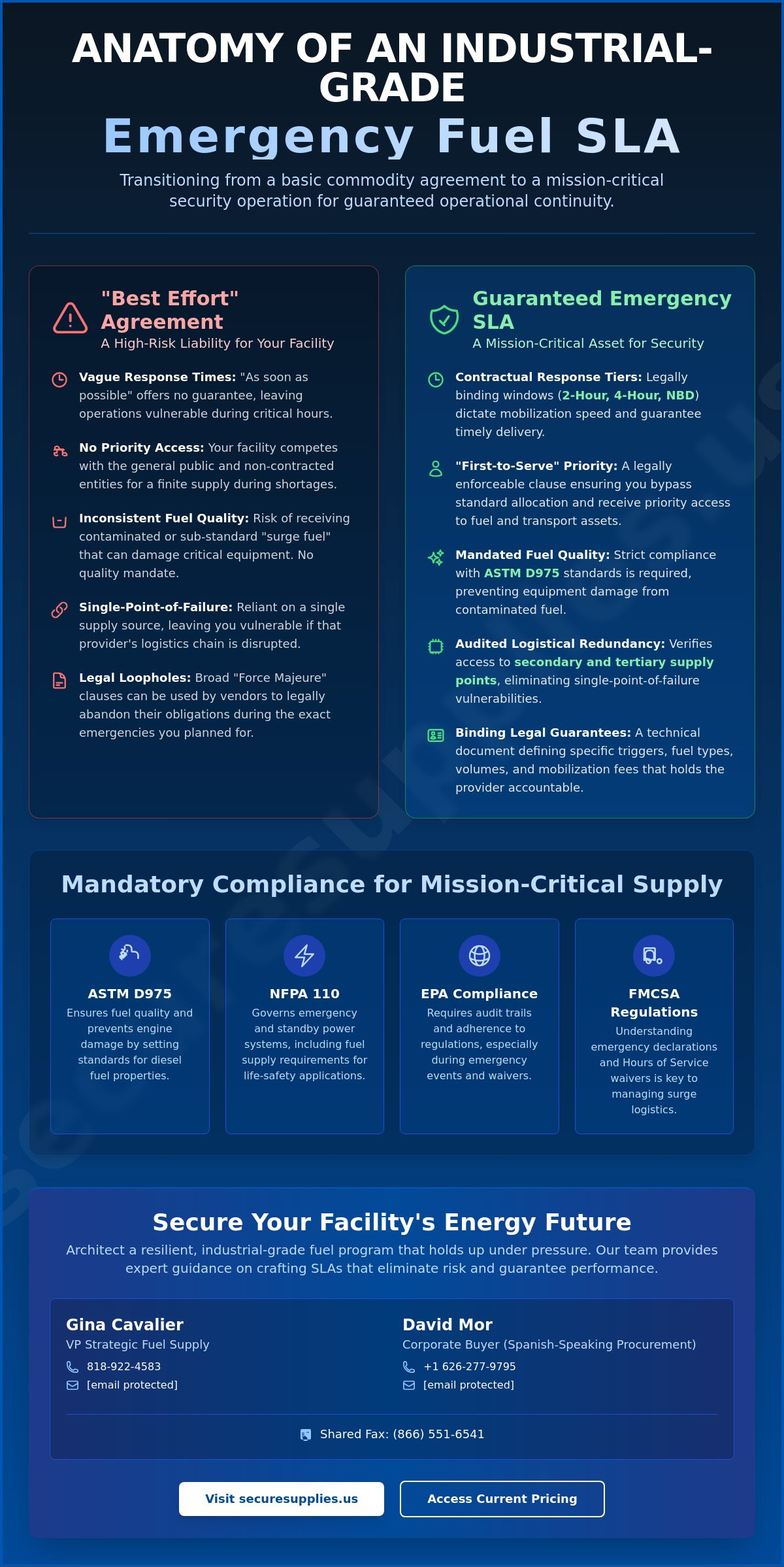
- Distinguish between a standard "best effort" agreement and a guaranteed emergency fuel delivery SLA to protect your facility from regional supply chain failures.
- Identify the specific response tiers and "First-to-Serve" priority clauses required to secure fuel during national shortages.
- Establish strict fuel quality protocols by mandating ASTM D975 compliance to prevent the risk of receiving contaminated surge fuel.
- Audit your logistics redundancy by verifying secondary and tertiary supply points to eliminate single-point-of-failure vulnerabilities.
- Transition to a strategic energy program that treats procurement as a mission-critical security operation rather than a basic commodity delivery.
Defining the Emergency Fuel Delivery SLA: Beyond the 24/7 Promise
Operational continuity depends on more than a vendor's verbal assurance. Many facilities operate under a "best effort" agreement, mistakenly assuming that a 24/7 availability claim translates to guaranteed delivery during a crisis. This is a dangerous misconception in industrial procurement. A professional Service-Level Agreement (SLA) is a technical document that defines the specific parameters of energy security. It moves fuel acquisition from a simple transaction to a strategic risk management tool. For data centers and other mission-critical infrastructure, a dedicated emergency fuel delivery SLA acts as the final barrier against catastrophic downtime.
Industrial energy infrastructure requires precise terminology to eliminate ambiguity. Your contract must define specific response windows, mobilization fees, and priority status. Without these, your facility is just another name on a long list of retail requests during a regional grid failure. With diesel prices seeing a 50.2 percent year-over-year increase as of April 2026, a structured SLA also provides a framework to manage volatility and supply rationing. For enterprises managing these high-volume transactions, Strictly offers an omni-channel payment processing platform that ensures financial operations remain as reliable as the fuel supply itself.
The Core Components of an Industrial SLA
Activating an SLA requires clearly defined triggers. An "emergency" shouldn't be left to the vendor's interpretation; it must include specific events like utility grid failure, natural disasters, or supply chain ruptures. The scope of service must detail every site, the specific fuel types required, and minimum volume commitments. Legal safeguards are equally vital. You must scrutinize Force Majeure clauses to ensure they don't allow providers to abandon deliveries during the very surge events they were hired to manage.
Why 'Best Effort' is a Risk to Continuity
Retail-focused providers often lack the logistics depth to handle simultaneous surges. During regional disasters, these vendors prioritize their largest aggregate margins or easiest routes. This leaves industrial sites vulnerable to supply rationing. A guaranteed contract protects your operation from price gouging and ensures you aren't sidelined by providers overwhelmed by retail demand. An emergency fuel delivery SLA is a legally binding commitment to specific response windows and quality standards.
Secure your infrastructure by auditing your current response guarantees today. For expert guidance on architecting a resilient energy program, contact our strategic team. Log in at login.securesupplies.us to access current pricing information and technical specifications.
Gina Cavalier, VP Strategic Fuel Supply
Phone: 818-922-4583
Email: [email protected]
David Mor, Corporate Buyer (Spanish-Speaking Procurement)
Phone: +1 626-277-9795
Email: [email protected]
Secure Supplies Group
Fax: (866) 551-6541
Web: securesupplies.us
Critical Performance Metrics: Response Times and Priority Access
Timing is the primary metric of any professional emergency fuel delivery SLA. In a crisis, "as soon as possible" is an unacceptable performance standard for critical infrastructure. Professional agreements utilize specific, time-bound tiers to eliminate ambiguity. These typically include 2-hour response windows for high-priority sites, 4-hour windows for standard industrial operations, and Next Business Day (NBD) tiers for non-critical replenishment. These windows are not suggestions. They are contractual obligations that dictate mobilization speed from the moment an emergency trigger is activated.
A "First-to-Serve" clause provides the legal teeth to these metrics. During regional disasters or national shortages, a vendor's capacity is finite. Without this clause, your facility competes with the general public and non-contracted entities for remaining inventory. An SLA ensures you bypass standard allocation limits. It mandates that contracted clients receive priority access to available fuel and transport assets. This is critical when the FMCSA issues emergency declarations, such as the one in effect until June 5, 2026, which allows carriers to manage surge demand by suspending certain safety regulations like Hours of Service.
Mobilization logistics require pre-staged assets before a predicted event. Professional providers monitor weather patterns and grid stability to position fuel trucks near high-risk zones. This proactive staging ensures that even if local infrastructure fails, your supply remains accessible. Documentation must be equally rigorous. Demand real-time GPS tracking and instant delivery confirmation protocols to maintain an audit trail for regulatory compliance. Ensuring all deliveries meet EPA diesel standards for Ultra-Low Sulfur Diesel (ULSD) remains mandatory, even during the most intense surge periods. If you are currently auditing your contingency plans, you can request a technical consultation for your site.
Tiered Response Windows for Mission-Critical Sites
Matching response speed to generator run-times and tank capacity is a fundamental requirement. For facilities requiring bulk fuel delivery for data centers, the logistics of multi-day outages demand pre-staged assets. You must verify a provider's local staging capabilities. Relying on a single regional hub creates a single point of failure. Redundant supply points ensure continuity if the primary depot is compromised.
Guaranteed Supply Volume and Rationing Protections
Standard fuel contracts often include rationing clauses that trigger during shortages. A mission-critical SLA must explicitly bypass these limits. This ensures continued access to specialized fuels like Jet A1 or Marine Diesel when retail supplies are exhausted. High-volume users should mandate "dedicated truck" clauses. This prevents your fuel from being diverted to other sites mid-route, ensuring your full volume arrives as scheduled.
Maintain your operational readiness by reviewing your priority status today. Log in at login.securesupplies.us to access current pricing information and supply availability.
Gina Cavalier, VP Strategic Fuel Supply
Phone: 818-922-4583
Email: [email protected]
David Mor, Corporate Buyer (Spanish-Speaking Procurement)
Phone: +1 626-277-9795
Email: [email protected]
Secure Supplies Group
Fax: (866) 551-6541
Web: securesupplies.us
Fuel Quality and Compliance Standards: ASTM and Regulatory Requirements
High-demand periods during regional crises often force providers to source fuel from secondary or unverified terminals. This "Emergency Surge Fuel" carries a high risk of contamination, particulate matter, and excessive moisture. An emergency fuel delivery SLA that lacks specific chemistry requirements is a liability for your infrastructure. Contaminated fuel does more than clog filters; it causes total generator failure at the exact moment your facility loses utility power. Reliability requires strict adherence to established standards throughout the supply chain.
Effective regional emergency fuel planning must integrate technical specifications into every procurement layer. For industrial diesel, the baseline is ASTM D975. This standard ensures the fuel's lubricity, viscosity, and cetane levels meet the requirements of modern high-pressure common rail engines. Relying on generic supply without these protections invites operational failure. Your SLA must mandate that every gallon delivered meets these federal and industry-recognized benchmarks without exception.
ASTM D975 and Fuel Integrity
Backup generators often sit idle for months, making them highly sensitive to fuel degradation and microbial growth. When fresh surge fuel is added to aged tank inventory, it can stir up sediment and accelerate filter plugging. Every emergency delivery must be accompanied by a Certificate of Analysis (COA) verifying ASTM D975 standards. Integrating regular tank testing and fuel polishing into your annual SLA review prevents long-term storage issues from becoming immediate outages. This proactive approach ensures your fuel remains "engine-ready" regardless of how long it has been in storage.
Regulatory Compliance and Environmental Safety
Compliance extends beyond fuel chemistry to the logistics of the delivery itself. Your provider must maintain rigorous Spill Prevention, Control, and Countermeasure (SPCC) protocols during high-stakes emergency offloading. All drivers must hold current HAZMAT certifications and remain compliant with DOT regulations, even when federal waivers are active. Verifying the provider's insurance coverage for high-volume industrial sites is a non-negotiable step in the audit process. These safeguards protect your facility from environmental liabilities during the chaos of a disaster response.
Maintain your compliance and secure your supply chain by reviewing technical specifications today. Log in at login.securesupplies.us to access current pricing information and fuel quality reports.
Gina Cavalier, VP Strategic Fuel Supply
Phone: 818-922-4583
Email: [email protected]
David Mor, Corporate Buyer (Spanish-Speaking Procurement)
Phone: +1 626-277-9795
Email: [email protected]
Secure Supplies Group
Fax: (866) 551-6541
Web: securesupplies.us
Logistics Redundancy and Multi-Site Management Checklist
A resilient emergency fuel delivery SLA must eliminate single points of failure. Relying on a single regional terminal is a high-stakes gamble during widespread grid failures or natural disasters. Professional logistics architects verify secondary and tertiary supply points to ensure continuity. This redundancy is particularly critical for multi-site operations where regional disruptions might compromise one supply hub while another remains operational. Auditing your provider's terminal access ensures they can pull from multiple refineries when local stocks are rationed.
Communication protocols must be direct and immediate. You can't afford to wait in a generic customer service queue during a mission-critical event. Secure agreements mandate dedicated 24/7 dispatch lines staffed by logistics experts who understand your specific site requirements. Remote tank monitoring should be integrated into the SLA to trigger automatic responses when levels hit a pre-defined threshold. This data-driven approach removes human error from the replenishment cycle and ensures your infrastructure stays online.
Equipment compatibility is another often overlooked logistical hurdle. Your provider must verify whether your site requires a full-size tanker or a smaller bobtail truck for tight access points. High-speed pumps are necessary for large-scale energy infrastructure to minimize offloading time and maximize efficiency. If your current provider hasn't conducted a site-specific equipment audit, your response plan is incomplete. To ensure your logistics are handled with this level of precision, request a comprehensive site audit and quote.
National Infrastructure and Supply Chain Security
Evaluating bulk fuel logistics companies requires a deep dive into their terminal access and contract structures. Non-branded supply contracts are essential. They allow providers to source fuel from various refineries rather than being tied to a single brand's availability. This flexibility is vital for managing fuel for trucking fleets across diverse geographic regions where brand-specific shortages may occur.
The Emergency Mobilization Checklist
Pre-event topping off is the most effective strategy to reduce emergency stress. Filling tanks before a predicted storm hits secures your immediate needs and reduces the strain on the delivery network. Site access verification is equally important. Your SLA should include a detailed dossier for every location, including gate codes, security clearances, and night-delivery protocols. This ensures drivers can offload fuel without delays, even if your facility is operating with minimal staff during the event.
Review your multi-site logistics today to identify potential failure points. Log in at login.securesupplies.us to access current pricing information and terminal availability updates.
Gina Cavalier, VP Strategic Fuel Supply
Phone: 818-922-4583
Email: [email protected]
David Mor, Corporate Buyer (Spanish-Speaking Procurement)
Phone: +1 626-277-9795
Email: [email protected]
Secure Supplies Group
Fax: (866) 551-6541
Web: securesupplies.us
Implementing Your Strategic Fuel Program with Secure Supplies Group
Establishing a resilient emergency fuel delivery SLA is the final step in securing your facility's operational continuity. Transitioning from a reactive procurement model to a strategic energy program requires a partner who understands the high stakes of industrial downtime. For many facility managers, this level of professional support also extends to their workforce; for comprehensive administrative and personnel management, visit Sullivan Group HR. Secure Supplies Group architects custom energy programs designed specifically for the industrial and commercial sectors. We don't view fuel delivery as a simple commodity trade. Instead, we treat every contract as a mission-critical security operation. Our team operates with the calm authority of a seasoned logistics partner, ensuring your infrastructure remains powered when regional supply chains fail.
Implementing a strategic program begins with a rigorous audit of your existing energy supply chain. We identify single points of failure and establish the technical benchmarks required for a 2026-ready agreement. This includes defining clear activation triggers and ensuring all fuel meets strict ASTM D975 standards. By integrating remote tank monitoring and direct dispatch protocols, we remove the uncertainty often associated with disaster response. This data-driven approach ensures that your emergency fuel delivery SLA provides a verifiable guarantee of priority access during national shortages.
The Secure Supplies Advantage
Our expertise is rooted in high-stakes environments where failure is not an option. We manage complex energy requirements for data centers, maritime operations, and aviation facilities. This specialized experience allows us to maintain high-purity standards and national logistics security across diverse geographic regions. Clients gain direct access to our strategic leadership for high-volume procurement needs. We prioritize transparency and meticulous planning, providing the stable backbone your operations require in a volatile market.
Secure Your 2026 Fuel Continuity
Readiness for the 2026 fuel season requires immediate action. The first step is evaluating your current site infrastructure and response guarantees. We offer site-specific audits to verify truck access, pump compatibility, and storage integrity. Accessing real-time data is streamlined through our secure account management portal. Log in at login.securesupplies.us to view current pricing information and technical specifications for your region. Our team is ready to architect a response framework that protects your critical infrastructure from the risks of regional grid failure and supply rationing.
Gina Cavalier, VP Strategic Fuel Supply
Phone: 818-922-4583
Email: [email protected]
David Mor, Corporate Buyer (Spanish-speaking procurement)
Phone: +1 626-277-9795
Email: [email protected]
Secure Supplies Group
Fax: (866) 551-6541
Web: securesupplies.us
Securing Your Operational Continuity for 2026
Securing 2026 energy infrastructure requires a shift from reactive procurement to a structured risk management framework. You've seen that a professional emergency fuel delivery SLA is the only way to bypass regional supply rationing and ensure priority access during a crisis. Reliability depends on more than a promise; it requires a national bulk fuel supply chain and an ASTM D975 quality guarantee. By auditing your response windows and mandating strict compliance standards, you protect your facility from the high costs of industrial downtime.
Secure Supplies Group provides the technical expertise and logistics depth needed for dedicated data center and industrial programs. Don't leave your continuity to chance during the next regional grid failure. Take the next step in architecting a resilient energy strategy. Contact Secure Supplies Group to establish your Emergency Fuel Delivery SLA today.
Log in at login.securesupplies.us to access current pricing information.
Gina Cavalier, VP Strategic Fuel Supply
818-922-4583 | [email protected]
David Mor, Corporate Buyer (Spanish-speaking procurement)
+1 626-277-9795 | [email protected]
Fax: (866) 551-6541
Website: securesupplies.us
Frequently Asked Questions
What is a standard response time for an emergency fuel delivery SLA?
Standard response times for mission-critical infrastructure like data centers and hospitals typically range from 2 to 4 hours. This specific window ensures that standby generators remain operational before on-site day tanks reach critical depletion levels. For non-critical industrial sites, a Next Business Day (NBD) tier is often sufficient. Every emergency fuel delivery SLA should explicitly define these time-bound tiers to eliminate ambiguity during a crisis.
Can an SLA guarantee fuel availability during a national disaster?
A professional SLA provides priority access through "First-to-Serve" clauses that bypass standard retail allocation limits. While a provider cannot control total national scarcity, a strategic program uses non-branded supply contracts to pull inventory from multiple refineries. This logistics redundancy ensures that contracted clients receive remaining inventory before the general public or non-contracted entities during a disaster.
How do fuel providers prioritize customers during a widespread power outage?
Providers prioritize deliveries based on the tier levels established in the contract. Contracted clients with a 2-hour or 4-hour emergency fuel delivery SLA are serviced first using pre-staged assets and dedicated trucks. Non-contracted retail customers are serviced only after all mission-critical obligations are met. This hierarchy is a legally binding commitment that protects your facility from being sidelined during a regional surge.
What ASTM standards should be cited in an emergency diesel contract?
ASTM D975 is the primary standard for ultra-low sulfur diesel and must be cited in all industrial contracts. For standby power systems, compliance with NFPA 110 is also necessary to ensure fuel quality and system reliability. These standards protect your engines from the contaminants and moisture often found in unverified surge fuel sourced during high-demand periods.
Is there a difference between a retail fuel delivery and an industrial SLA?
Retail fuel delivery is generally a "best effort" service with no guaranteed response time or priority status. An industrial SLA is a formal logistics architecture that includes mobilization fees, defined response windows, and quality guarantees. Industrial agreements also include rigorous documentation and compliance reporting that retail providers often lack. This structure moves fuel procurement from a simple transaction to a strategic security operation.
How much does an emergency fuel delivery contract typically cost?
Costs for emergency contracts are usually structured as an annual readiness retainer plus mobilization fees per event. These fees depend on the number of sites, required response speed, and total volume commitments. Because pricing is market-reflective and specific to your facility's infrastructure, you should log in at login.securesupplies.us to access current pricing information and program details.
What happens if a fuel provider fails to meet the SLA response window?
A robust contract includes clearly defined defaults and remedies, such as service credits or penalty clauses for missed windows. It's essential to define the triggers for these penalties and the documentation required to verify the delay. These clauses provide the necessary accountability to ensure your provider treats your facility as a high-priority site during a mobilization event.
Can I include DEF and industrial gases in my emergency fuel SLA?
Yes, comprehensive energy programs can integrate DEF (AdBlue) and industrial gases like O2 or N2 into a single emergency framework. This ensures that both your power infrastructure and your fleet remain compliant with EPA standards during a crisis. Bundling these supplies allows for more efficient logistics and ensures that all mission-critical consumables are managed under a single priority response protocol.
For expert assistance in architecting your strategic fuel program, contact our team today. Log in at login.securesupplies.us to access current pricing and technical specifications.
Gina Cavalier, VP Strategic Fuel Supply
Phone: 818-922-4583
Email: [email protected]
David Mor, Corporate Buyer (Spanish-speaking procurement)
Phone: +1 626-277-9795
Email: [email protected]
Secure Supplies Group
Fax: (866) 551-6541
Web: securesupplies.us
Disclaimer
The information provided in this article is for general informational purposes only and does not constitute professional, legal, safety, or financial advice. Fuel and energy product specifications, pricing, availability, and regulatory requirements vary by location, application, and over time, and may differ from the general information presented here. Secure Supplies makes no warranties regarding the accuracy, completeness, or current applicability of this content. Handling, storage, and use of fuels and industrial gases can be hazardous and should always follow applicable laws, manufacturer guidance, and qualified professional advice. For current specifications, pricing, and tailored supply solutions, please contact Secure Supplies directly.