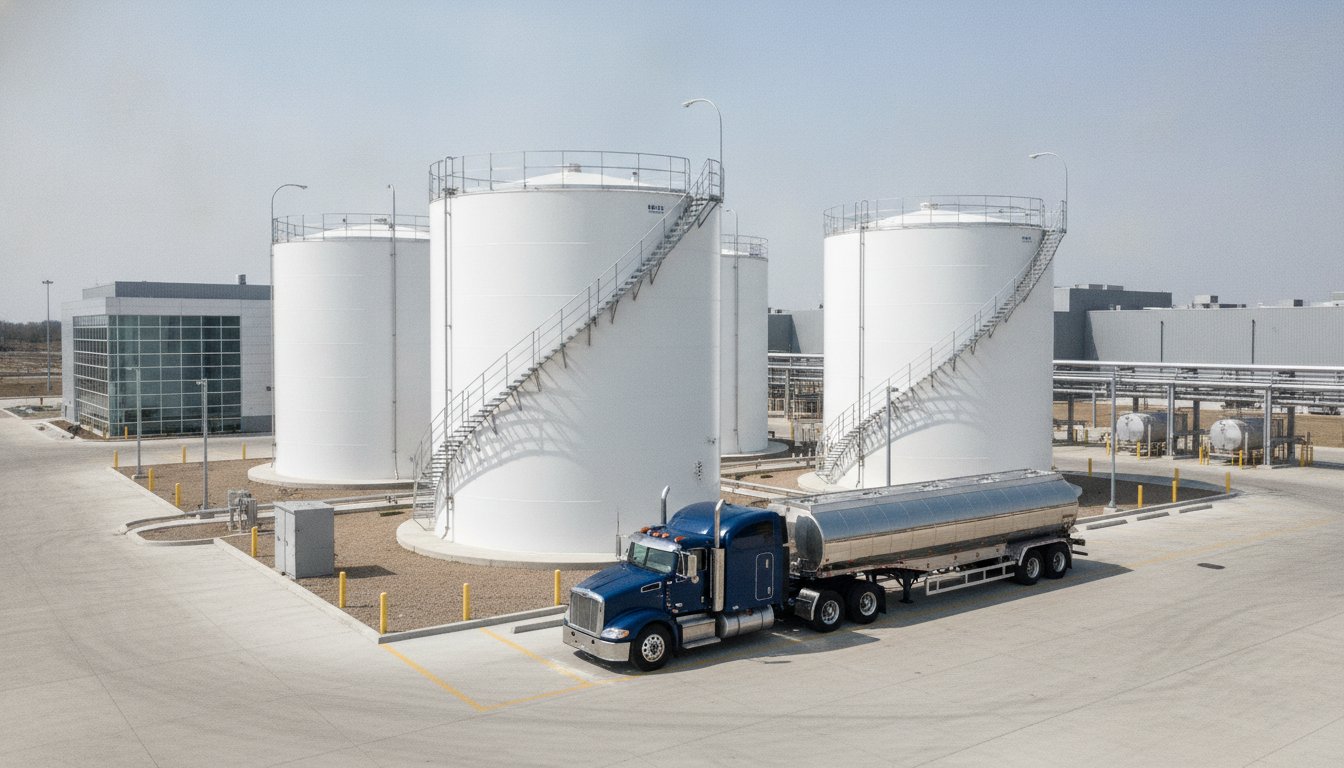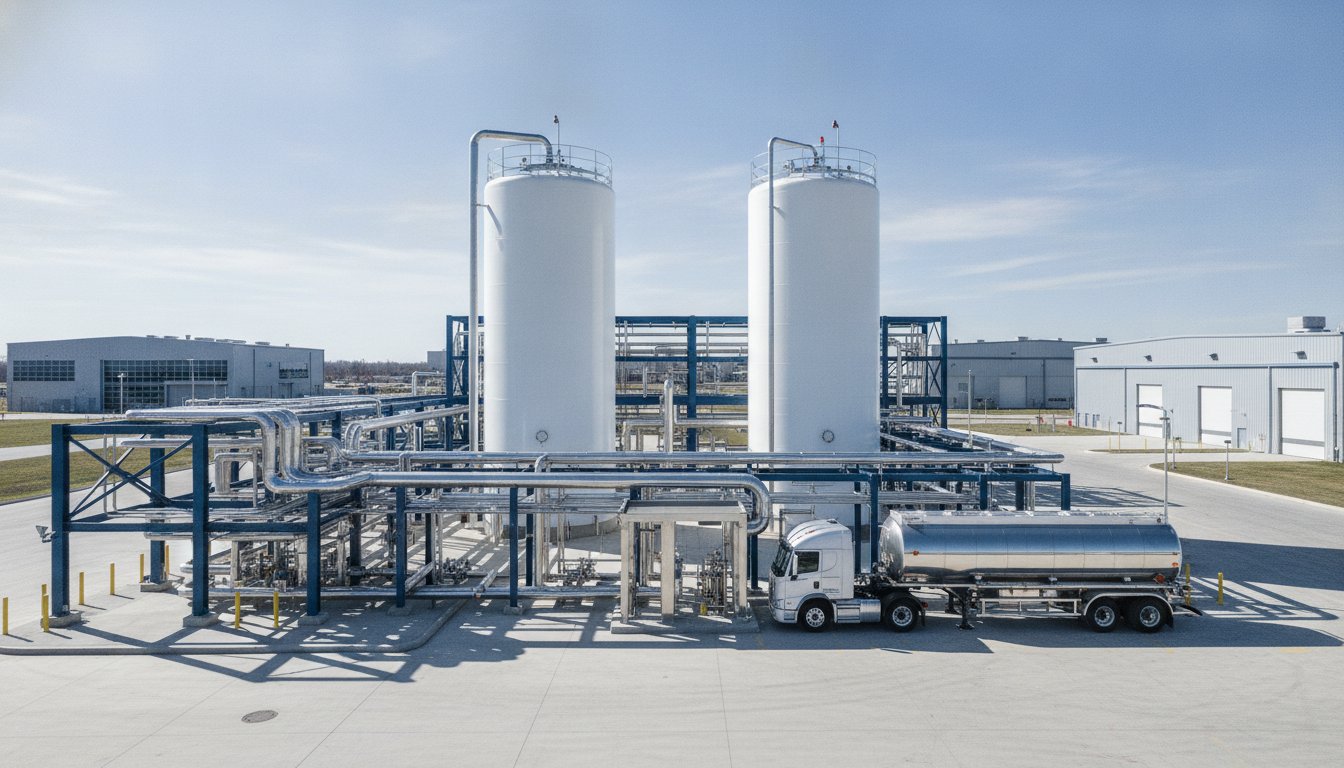

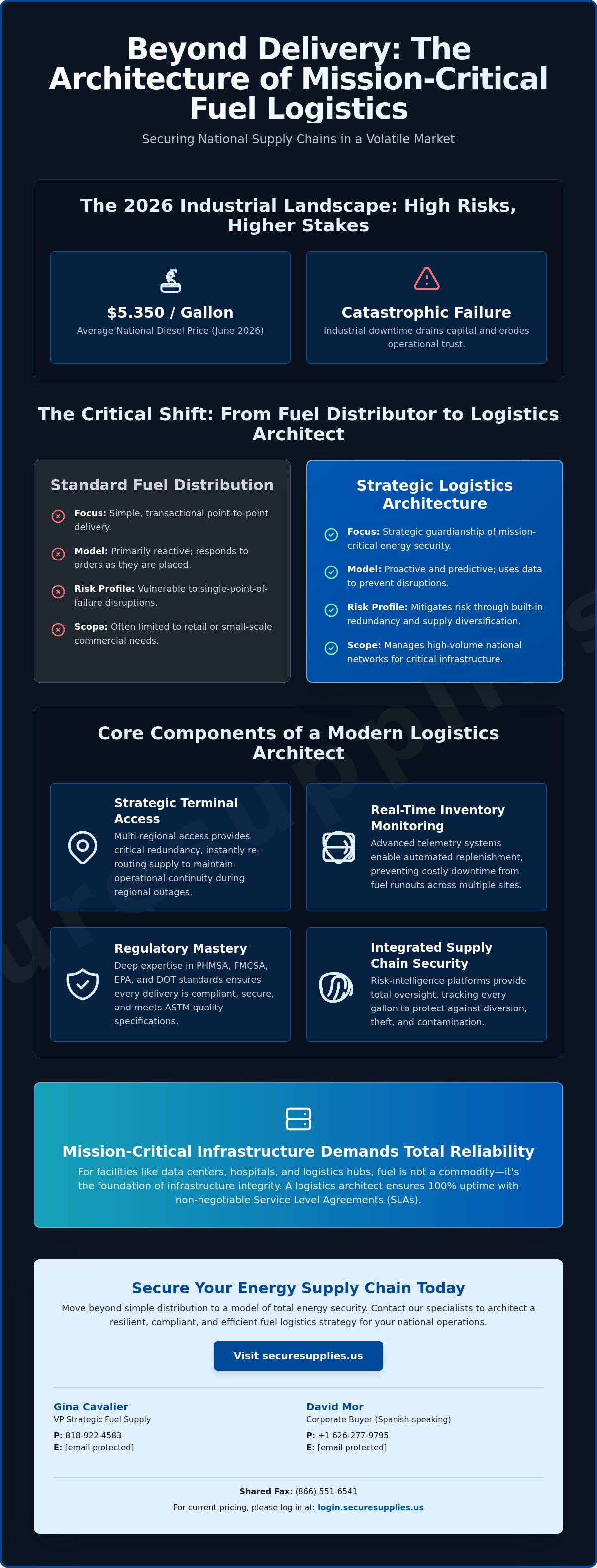
With national diesel prices averaging $5.350 per gallon in June 2026, a single delivery delay doesn't just disrupt your schedule; it threatens your entire operational solvency. You already know that supply chain volatility is the new baseline for industrial operations. Industrial downtime isn't a minor inconvenience. It's a catastrophic failure of infrastructure that drains capital and erodes trust. Leading bulk fuel logistics companies must act as strategic architects rather than simple transporters to survive this high-stakes environment.
We'll show you exactly how elite partners secure mission-critical energy supply chains against these 2026 market pressures. You'll discover what to look for in a national partner, from their ability to manage complex multi-site procurement to their mastery of the latest PHMSA and FMCSA regulatory updates. We'll examine how to maintain an uninterrupted energy supply and reduce operational risk through scalable logistics solutions. This guide provides the bottom-line criteria for selecting a partner who treats your fuel supply as the essential backbone of your daily success. It's time to move beyond simple distribution and toward a model of total energy security.
Key Takeaways
- Differentiate between standard retail distribution and the strategic oversight provided by elite bulk fuel logistics companies to protect national supply chains.
- Analyze how strategic fuel positioning and terminal access mitigate the risks of industrial downtime and supply chain volatility.
- Evaluate why mission-critical facilities like data centers require a logistics architect approach to ensure total infrastructure integrity.
- Identify the essential Service Level Agreement (SLA) metrics needed to guarantee redundancy and reliability in energy procurement.
- Explore the operational efficiency of integrating bulk fuel delivery with industrial gas supply to streamline multi-site logistics.
Defining the Role of Bulk Fuel Logistics Companies in 2026
Bulk fuel logistics in 2026 represents the strategic architecture of high-volume energy supply chains. It isn't just about moving a commodity from one point to another. It's about ensuring operational continuity for the nation's critical infrastructure. Elite bulk fuel logistics companies operate as strategic guardians of industrial uptime. Unlike retail gas distributors that focus on individual consumer transactions, industrial-scale partners manage the complex flow of millions of gallons of fuel through integrated national networks. In 2026, the focus has shifted entirely toward mission-critical energy security. This shift is driven by a volatile global market where diesel prices reached $5.350 per gallon in June 2026, making the expertise of trade facilitators like Global Exclusive Trading (GET) essential for connecting domestic needs with international market opportunities. National reach is no longer a luxury for multi-site commercial enterprises; it's a requirement for maintaining a cohesive procurement strategy across diverse geographic regions.
Effective logistics management relies on understanding the various methods of petroleum transport, including pipelines, rail, and specialized cargo tanks. Industrial logistics isn't a one-size-fits-all service. It requires a deep understanding of the regulatory landscape, such as the PHMSA final rule (Docket 2026-00578) effective February 13, 2026, which modernized cargo tank inspection requirements. This technical expertise ensures that high-volume energy supplies remain compliant and secure while reducing unnecessary regulatory burdens on the transport chain.
The Core Components of Industrial Logistics
High-volume procurement strategies for diesel, CNG, and LNG require a "logistics architect" mindset. Success depends on real-time inventory monitoring and automated replenishment systems that prevent costly industrial downtime. These systems utilize telemetry to track tank levels across multiple sites simultaneously. Compliance is the foundation of these operations. Logistics providers must adhere to rigorous EPA and DOT standards, including the March 2026 FMCSA rule updates regarding fuel-tank overfill regulations and emergency equipment requirements for vehicles transporting flammable liquids. Meticulous planning ensures that every gallon delivered meets ASTM quality specifications.
Commercial vs. Residential Logistics Models
Industrial logistics requires specialized equipment and high-flow pumping capabilities that residential models simply cannot provide. Commercial fueling operations utilize heavy-duty tankers designed for rapid discharge into large-scale storage tanks. By excluding retail services like residential heating oil or small-scale propane exchange, industrial logistics partners maintain a singular focus on high-volume efficiency. This specialization allows for scaling logistics to meet the immense demands of national trucking fleets and maritime bunkering. The goal is a streamlined procurement process that treats energy as a mission-critical utility rather than an occasional delivery.
The Architecture of High-Volume Fuel Distribution and Supply Chain Security
High-volume distribution relies on a sophisticated multi-modal network. Moving millions of gallons requires more than just transport; it requires a deep understanding of terminal capacity and throughput. Citing the DOD's Bulk Fuel Program highlights the immense complexity involved in managing large-scale energy requirements for mission-critical operations. Leading bulk fuel logistics companies prioritize terminal access across multiple regions to ensure redundancy. This prevents the "single point of failure" that often disrupts industrial supply chains. If a primary terminal faces an outage, a strategic partner reroutes supply instantly to maintain continuity. Strategic positioning isn't just about geography; it's about having the contractual leverage to secure fuel when regional supplies tighten.
Security in 2026 encompasses both physical protection and digital oversight. With diesel prices at $5.350 per gallon in June 2026, the incentive for fuel diversion or theft has never been higher. Proactive logistics providers now integrate risk-intelligence platforms to monitor supply chains against geopolitical and physical threats. These platforms ensure fuel integrity by tracking every gallon from the source to the final drop. Implementing robust energy infrastructure projects allows organizations to harden their storage sites against these external volatilities. Technology acts as the silent guardian of the supply chain, providing real-time data on transit times and fuel quality metrics.
Maritime Bunkering and Super Yacht Logistics
Maritime bunkering and super yacht logistics demand a specialized operational framework. Marine diesel delivery must comply with stringent international fuel quality standards and port-specific safety protocols. Navigating the logistics of a busy port requires meticulous timing and coordination with harbor masters. Super yacht fueling programs require a high degree of discretion and technical precision. These vessels often operate on tight schedules where even a minor delay in bunkering can disrupt an entire itinerary. Logistics architects manage these variables to ensure seamless, high-purity fuel transfers that meet maritime environmental regulations.
Aviation Fuel Supply Chain Management
Aviation fuel supply chain management is defined by its zero-tolerance for error. The distribution of Jet A1 for commercial aviation requires rigorous testing and filtration at every stage of the journey. Maintaining fuel purity from the refinery to the tarmac is essential for flight safety and engine performance. Bulk fuel logistics companies must manage just-in-time deliveries for high-traffic aviation hubs where storage space is often limited. This requires a constant flow of verified, compliant fuel that meets all ASTM specifications. Reliability in this sector is measured by the ability to prevent any interruption in the fueling cycle while maintaining the highest safety standards.
Mission-Critical vs. Standard Delivery: Why Infrastructure Integrity Matters
Mission-critical infrastructure demands a level of reliability that standard delivery models cannot provide. For data centers, hospitals, and emergency response hubs, energy isn't just a commodity; it's a life-sustaining requirement. A single point of failure in the fuel supply chain translates directly to catastrophic downtime. Elite bulk fuel logistics companies differentiate themselves by moving beyond reactive "emergency delivery" to a model of proactive strategic reserve management. This transition is essential in 2026. Market volatility and supply chain disruptions, as noted in previous sections, make reliance on "just-in-time" delivery a high-risk gamble for industrial operators.
Relying on a phone call during a regional outage is a failed strategy. A logistics architect approach treats energy infrastructure as an integrated system. It involves calculating burn rates, managing onsite inventory, and establishing secondary and tertiary supply lines. This ensures that when the primary grid fails, the transition to backup power is seamless and sustained. Strategic reserve management requires foresight. It means securing fuel volumes before a crisis hits and maintaining those reserves with the same precision used in daily operations. This proactive stance reduces the risk of industrial downtime and stabilizes procurement costs in a fluctuating market.
Fuel integrity is often the overlooked link in the chain. Stored diesel degrades over time. Microbial growth and water accumulation can compromise generator performance when it matters most. Adhering to ASTM D975 standards for fuel quality isn't optional; it's a requirement for system reliability. Regular fuel polishing and rigorous maintenance schedules are mandatory components of any mission-critical energy program. Without these safeguards, the most sophisticated backup system is only as good as the degraded fuel sitting in its tanks.
Data Center Energy Programs
Data centers require specialized fueling protocols to maintain 100% uptime during multi-day outages. These programs integrate bulk fuel logistics with microgrid planning and redundancy strategies. Maintaining fuel integrity for massive backup generator arrays involves constant monitoring and rapid replenishment cycles. Logistics providers must understand the specific load requirements of the facility to ensure that delivery schedules match real-time consumption rates during an emergency. This level of coordination prevents the depletion of onsite reserves during prolonged grid failures.
Energy Infrastructure Project Management
Designing and managing large-scale onsite fuel storage solutions is the foundation of energy security. This includes overseeing the installation of specialized energy delivery systems and storage tanks that meet all EPA and DOT safety requirements. Long-term operational continuity is ensured through regular infrastructure audits. These audits identify potential vulnerabilities in the storage and delivery hardware before they lead to a system failure. By managing the project from design through long-term maintenance, logistics partners provide a steady hand in a volatile energy market.
Strategic Procurement: Evaluating Reliability and Redundancy in Your Logistics Partner
Procurement professionals can't rely on luck when managing national energy supplies. Evaluation of bulk fuel logistics companies requires a rigorous, data-driven framework. With transport costs climbing to $0.90 per mile in May 2026, logistical efficiency directly impacts your bottom line. You must verify a partner's terminal access and their contractual standing during regional shortages. A partner without multi-source capabilities leaves your operation vulnerable to localized terminal outages. Reliability is a measurable metric, not a marketing claim.
Service Level Agreements (SLAs) provide the necessary safeguards for industrial energy procurement. These documents must explicitly define delivery windows, fuel quality adherence to ASTM standards, and emergency response protocols. Scaling during a national crisis requires pre-positioned assets and a clear command structure. A strategic partner simplifies the intake process by centralizing procurement for diverse energy needs. This includes Bulk Fuel Delivery and specialized programs like CNG or LNG supply. Managing complexity is the partner's job, not yours.
The Reliability Checklist for Fleet Managers
Fleet managers need concrete proof of operational capability. Start by verifying terminal access and multi-source supply agreements across your entire geographic footprint. Assess safety records and Hazmat transportation compliance, specifically looking for adherence to the March 2026 FMCSA updates on fuel-tank overfill and emergency equipment. Real-time reporting and billing transparency are non-negotiable requirements. You need to see where your fuel is and what it costs at every stage of the journey. Automated telemetry systems provide this visibility without manual intervention.
Redundancy Planning and Risk Mitigation
High-stakes operations require a secondary supply line to ensure continuity. This involves identifying alternative terminals and transport routes before a disruption occurs. Redundancy planning also extends to essential additives like DEF / AdBlue Supply, which is critical for modern SCR-equipped fleets. Leveraging multi-site management allows for national logistical efficiency by balancing inventory across multiple locations. For retail and e-commerce brands, this level of coordination is provided by EZ3PL Ltd, which offers end-to-end fulfilment solutions to keep supply chains moving. This strategic approach mitigates the risk of industrial downtime and ensures your fleet remains operational regardless of regional market volatility.
Comprehensive Energy Logistics: The Secure Supplies Group Advantage
Secure Supplies Group provides a unified framework for energy and gas procurement. Many bulk fuel logistics companies operate with fragmented supply chains, separating liquid fuels from industrial gases. This fragmentation creates unnecessary complexity and risk for facility directors. We eliminate these silos by integrating Bulk Fuel Delivery with a comprehensive suite of industrial and medical gases. This synergy allows fleet managers and engineers to consolidate their procurement under a single, authoritative partner. Managing a unified supply chain reduces the administrative burden and ensures that every energy component is handled with the same high-stakes professionalism.
Consolidating your O2, N2, Helium, and CO2 needs with your fuel supply simplifies your logistical footprint. This integrated approach ensures that every part of your critical infrastructure is managed with meticulous attention to detail. We act as the strategic guardian of your supply chain, providing the stability required in a volatile market. With diesel prices reaching $5.350 per gallon in June 2026, the need for a partner who understands the big picture of energy security is vital. We don't just deliver fuel; we architect a redundant system that protects against industrial downtime.
Industrial and Medical Gas Procurement
Reliability is paramount in medical and industrial gas supply. We provide O2 Oxygen and N2 Nitrogen (Medical Liquid and Gas) to healthcare facilities that require absolute supply continuity. Our helium and food-grade CO2 programs support advanced manufacturing and food processing sectors across the country. Every delivery meets stringent purity standards required for specialized applications. We maintain rigorous compliance with all relevant regulatory bodies to ensure that your gas requirements are met without compromise. This technical approach guarantees that your operations remain within regulated standards while maintaining high-flow efficiency.
Nationwide Reach with Specialized Expertise
Our expertise extends across the United States. We manage complex energy infrastructure projects and multi-site fueling programs with a focus on national scale. The mission-critical mindset means failure is not an option. Whether you're managing a data center energy program or a national trucking fleet, our logistics architects provide the foresight needed to prevent disruptions. We handle the minute details of delivery and compliance so you can focus on core operations. Secure your energy supply chain with Secure Supplies Group.
To secure your national supply chain and ensure operational continuity, visit securesupplies.us.
Strategic Contact Information:
Gina Cavalier, VP Strategic Fuel Supply
Phone: 818-922-4583
Email: [email protected]
David Mor, Corporate Buyer (Spanish-speaking Secure Supplies Group)
Phone: +1 626-277-9795
Email: [email protected]
Fax: (866) 551-6541
For current pricing and account management, please log in at login.securesupplies.us.
Secure Your Infrastructure Against Energy Volatility
Energy security in 2026 depends on more than just timely delivery. It requires a partner who acts as a strategic guardian for your critical infrastructure. Evaluating bulk fuel logistics companies based on their terminal access and mastery of recent PHMSA and FMCSA regulations ensures your operations remain insulated from global market volatility. Integrated logistics for both liquid fuels and industrial gases provide a streamlined procurement model that reduces administrative burdens while maximizing supply chain redundancy. You've seen how mission-critical facilities like data centers and hospitals rely on this architectural approach to prevent catastrophic downtime. By prioritizing infrastructure integrity and proactive reserve management, you position your organization for long-term stability.
Secure Your National Energy Supply Chain with Secure Supplies Group. Trust our mission-critical energy infrastructure experts to provide the integrated fuel and industrial gas logistics your operation demands. We're committed to ensuring your success through unwavering reliability and meticulously planned redundancy.
For strategic support, contact Gina Cavalier, VP Strategic Fuel Supply (818-922-4583, [email protected]) and David Mor, Corporate Buyer for the Spanish-speaking Secure Supplies Group (+1 626-277-9795, [email protected]), both sharing the fax number (866) 551-6541. Log in at login.securesupplies.us for current pricing.
Frequently Asked Questions
What is the difference between a fuel distributor and a bulk fuel logistics company?
A bulk fuel logistics company provides strategic oversight and national infrastructure management, whereas a standard distributor focuses on localized, point-to-point delivery. Bulk fuel logistics companies act as architects of your entire energy supply chain. They manage terminal access and multi-modal transport to ensure redundancy. This level of planning prevents industrial downtime by identifying secondary supply lines before a regional shortage occurs.
How do bulk fuel logistics companies ensure supply during a national shortage?
Supply continuity during a national shortage is maintained through multi-source terminal access and pre-negotiated priority contracts. Strategic partners manage fuel volumes at various geographic hubs to bypass localized disruptions. This approach leverages contractual strength to secure fuel when market availability is low. It moves beyond "just-in-time" models to a more resilient, reserve-based strategy.
Can one logistics company handle both liquid fuels and industrial gases?
Comprehensive logistics providers like Secure Supplies Group integrate liquid fuel delivery with industrial and medical gas procurement. This unified model simplifies the intake process for complex facilities. Managing O2, N2, and CO2 alongside bulk diesel reduces administrative overhead. It also ensures that all mission-critical energy and gas supplies meet consistent safety and purity standards under one authoritative guardian.
What industries require mission-critical bulk fuel logistics?
High-stakes sectors such as data centers, healthcare facilities, and national logistics fleets require mission-critical support. These industries can't tolerate a single point of failure in their energy supply. Aviation and maritime bunkering operations also demand this level of precision. Any interruption in these sectors leads to significant financial loss or immediate risk to public safety.
How does a Service Level Agreement (SLA) protect my fuel supply?
An SLA acts as a binding framework that guarantees priority status and specific delivery windows during market volatility. It establishes clear performance metrics for fuel quality and response times. These agreements ensure that your facility receives supply ahead of non-contracted customers during regional shortages. It provides the legal and operational certainty required for long-term infrastructure planning.
What are the safety requirements for bulk fuel transportation in 2026?
Safety requirements in 2026 include adherence to the PHMSA final rule effective February 13, 2026, which modernized cargo tank inspection standards. Transporters must also comply with March 2026 FMCSA updates regarding fuel-tank overfill regulations and emergency equipment. These technical standards ensure that high-volume hazardous materials are moved with minimal risk to the public or the environment.
How do logistics companies manage maritime bunkering for super yachts?
Maritime bunkering for super yachts requires specialized high-flow equipment and strict adherence to international fuel quality standards. Logistics partners coordinate directly with harbor masters and port authorities to manage delivery windows. This process demands technical precision to ensure fuel purity and prevent environmental incidents during transfer. Discretion and timing are essential for maintaining the operational schedules of these vessels.
Is bulk DEF delivery included in industrial fuel logistics programs?
Bulk DEF/AdBlue delivery is a standard component of integrated industrial fueling programs. Modern SCR-equipped fleets require consistent DEF supply to remain operational and compliant with EPA emissions standards. Leading bulk fuel logistics companies provide automated replenishment of DEF alongside diesel deliveries. This prevents the risk of engine derate or shutdown due to empty urea tanks.
Disclaimer
The information provided in this article is for general informational purposes only and does not constitute professional, legal, safety, or financial advice. Fuel and energy product specifications, pricing, availability, and regulatory requirements vary by location, application, and over time, and may differ from the general information presented here. Secure Supplies makes no warranties regarding the accuracy, completeness, or current applicability of this content. Handling, storage, and use of fuels and industrial gases can be hazardous and should always follow applicable laws, manufacturer guidance, and qualified professional advice. For current specifications, pricing, and tailored supply solutions, please contact Secure Supplies directly.