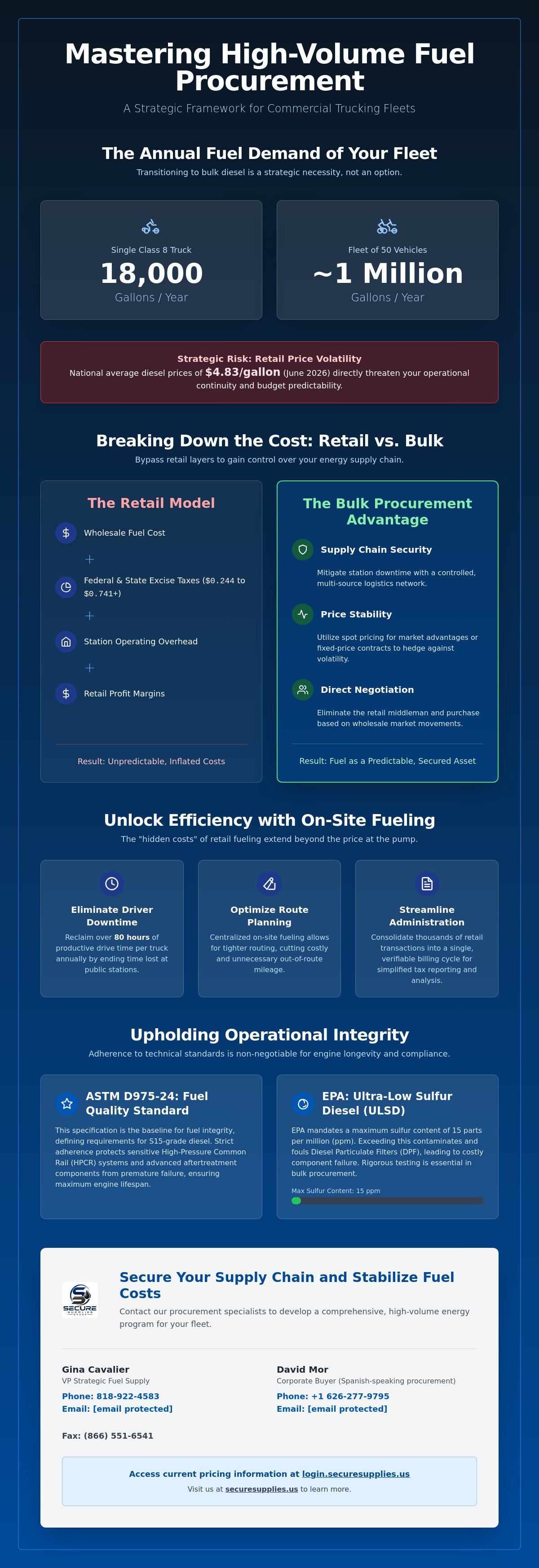
A single Class 8 truck consumes approximately 18,000 gallons of fuel annually. For a fleet of 50 vehicles, this translates to a requirement of nearly one million gallons every year. You already recognize that relying on public retail infrastructure is a strategic risk. With national average diesel prices reaching $4.83 per gallon as of June 2026, retail volatility is a direct threat to your operational continuity.
Transitioning to bulk diesel for trucking fleets is the only way to regain control over your energy supply chain. This guide provides the technical framework to master high-volume procurement, ensuring your infrastructure meets ASTM D975-24 quality standards and EPA spill prevention requirements. We will analyze the logistics of on-site storage, the impact of the March 2026 FMCSA regulatory updates, and the strategies for managing multi-regional vendor networks. You'll gain the precision needed to turn fuel from a variable cost into a predictable, secured asset.
Key Takeaways
- Mitigate retail price volatility and eliminate station downtime by transitioning to a controlled, high-volume procurement strategy.
- Maintain engine longevity and operational integrity by strictly adhering to ASTM D975 standards and EPA Ultra-Low Sulfur Diesel (ULSD) regulations.
- Strengthen supply chain security through a multi-source logistics network that prioritizes terminal access and redundancy to prevent industrial downtime.
- Optimize on-site infrastructure by selecting storage solutions that comply with EPA SPCC plans and current DOT requirements for hazardous materials.
- Implement comprehensive energy programs that integrate bulk diesel for trucking fleets with essential support fluids like DEF and alternative fuels such as CNG and LNG.
The Economics and Logistics of Bulk Diesel for Trucking Fleets
Industrial-scale trucking operations can't survive on retail fuel strategies. For a national fleet, diesel isn't just a commodity; it's the primary driver of operational overhead. Transitioning to bulk diesel for trucking fleets represents a fundamental shift from reactive purchasing to a controlled energy architecture. This move replaces the unpredictability of public station pricing with a secured, wholesale supply chain. To understand the scale of this requirement, one must look at a Diesel fuel overview to grasp the specific energy density and infrastructure needs of heavy-duty engines. Managing this energy at scale requires a logistics-first mindset that prioritizes security and price stability.
Wholesale vs. Retail: Breaking Down the Cost Architecture
Retail fuel pricing is a composite of several layers that inflate your per-gallon cost. These include federal and state excise taxes, station operating overhead, and retail profit margins. As of June 2026, the federal excise tax stands at $0.244 per gallon, while state taxes in regions like Pennsylvania can reach as high as $0.741 per gallon. Strategic bulk fuel delivery bypasses the retail middleman, allowing fleet managers to negotiate directly based on wholesale market movements. This procurement model offers two primary paths for budgeting. Spot pricing allows for immediate market advantages, while fixed-price contracts provide a hedge against the volatility often seen in the national average, which hit $4.83 per gallon in June 2026. Eliminating the station markup is only the first step in protecting your margins.
The Logistical Advantage of On-Site Fueling
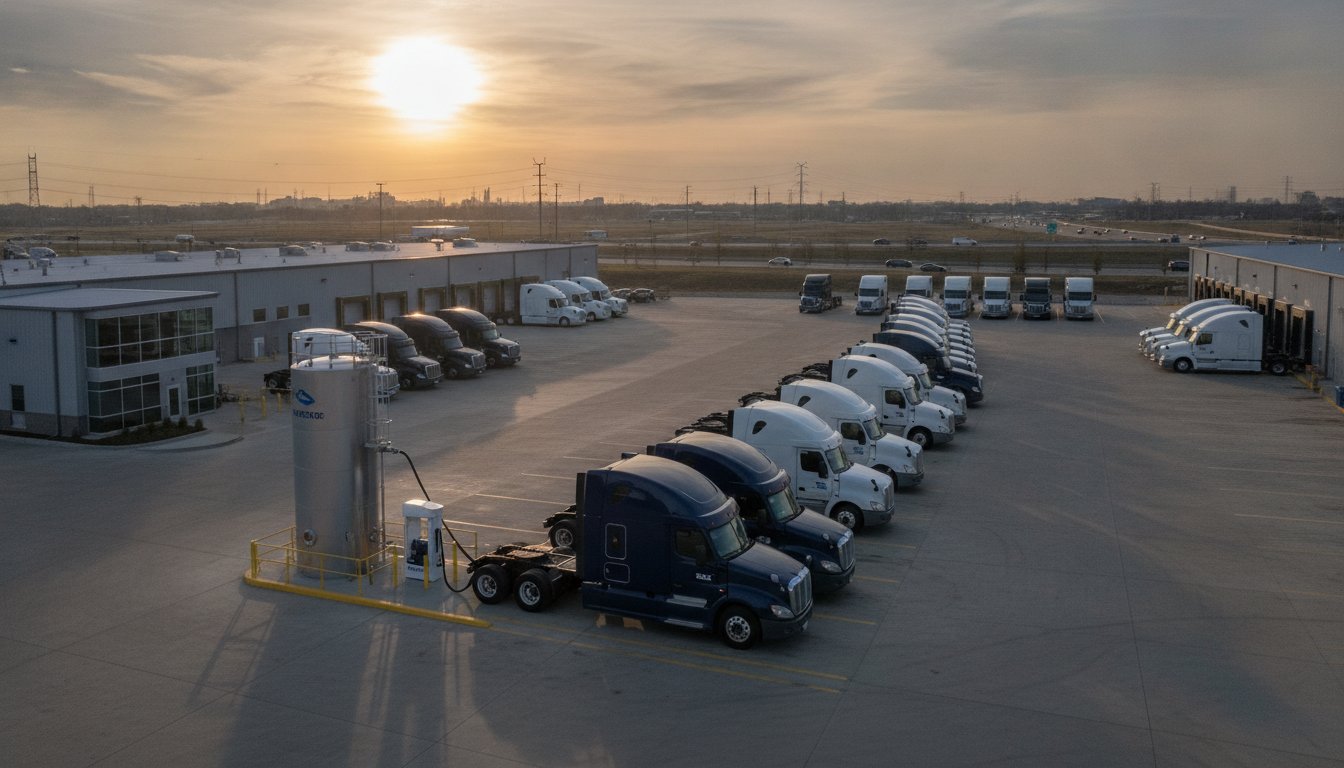
The "hidden costs" of retail fueling often exceed the price at the pump. Public stations introduce two major drains on efficiency: driver downtime and out-of-route mileage. If a driver spends 20 minutes per day navigating a public fueling station, that fleet loses over 80 hours of productive drive time per truck annually. Centralized fueling on-site eliminates these bottlenecks. It allows for tighter route optimization and ensures that trucks are fueled during mandatory rest periods or staging. Beyond the road, the administrative benefits are significant. Bulk diesel for trucking fleets streamlines procurement by consolidating thousands of individual retail transactions into a single, verifiable billing cycle. This reduces administrative overhead and provides the granular data needed for accurate fuel tax reporting and engine performance analysis.
Secure your supply chain and stabilize your fuel costs today. For strategic fuel supply inquiries, contact our team:
Gina Cavalier, VP Strategic Fuel Supply
Phone: 818-922-4583
Email: [email protected]
David Mor, Corporate Buyer (Spanish-speaking procurement)
Phone: +1 626-277-9795
Email: [email protected]
Fax: (866) 551-6541
Access current pricing information at login.securesupplies.us. Visit us at securesupplies.us.
Fuel Quality Standards: ASTM D975 and Operational Integrity
Operational integrity for heavy-duty assets begins with the chemical composition of the fuel. High-pressure common rail (HPCR) systems and advanced aftertreatment components require precision that exceeds traditional retail standards. Adhering to the ASTM D975-24 standard is the baseline for maintaining these systems. This specification defines the requirements for various grades of diesel, including the S15 grade used in almost all on-highway applications. For bulk diesel for trucking fleets, ensuring every gallon meets these metrics is a prerequisite for engine longevity and regulatory compliance.
The transition to Ultra-Low Sulfur Diesel (ULSD) was driven by the need to reduce particulate matter and nitrogen oxides. Current EPA diesel fuel standards mandate a maximum sulfur content of 15 parts per million (ppm). If sulfur levels exceed this threshold, Diesel Particulate Filters (DPF) can become permanently fouled, leading to expensive forced regenerations or total component failure. High-volume procurement must include rigorous testing to ensure that supply chain transitions don't introduce high-sulfur contaminants into your bulk storage tanks.
Technical Specifications of Industrial Grade Diesel
Fuel performance varies by season and region. Cetane ratings determine ignition delay; higher ratings improve cold-start performance and reduce combustion noise. Lubricity is equally critical. Because the desulfurization process removes natural lubricants, additives must be present to protect fuel pumps and injectors from premature wear. For those seeking comprehensive procurement options for both fuel and engine lubricants, you can discover Fleetmaxx Solutions. During winter months, procurement strategies must shift to include seasonal blending. This prevents paraffin wax from precipitating and clogging filters when temperatures drop below the fuel's cloud point.
Fuel Integrity and Contamination Prevention
Bulk storage introduces risks that retail pumps often mask. Water is the most persistent threat. It enters tanks through condensation and provides a breeding ground for microbial growth. These "fuel bugs" create acidic sludge that corrodes tank linings and destroys engine components. Maintaining bulk diesel for trucking fleets requires consistent vigilance against particulates and moisture. SCR system health is also vital. Utilizing bulk AdBlue supply services ensures that your Diesel Exhaust Fluid meets ISO 22241 standards, preventing urea crystallization in the dosing system. Implementing a fuel polishing protocol for your bulk tanks is a proactive step toward total system security.
Evaluate your current fuel quality protocols to ensure they meet 2026 standards. Request a technical consultation on fuel integrity to protect your fleet's assets.
Gina Cavalier, VP Strategic Fuel Supply
Phone: 818-922-4583
Email: [email protected]
David Mor, Corporate Buyer (Spanish-speaking procurement)
Phone: +1 626-277-9795
Email: [email protected]
Fax: (866) 551-6541
Access current pricing information at login.securesupplies.us. Visit us at securesupplies.us.
Assessing Nationwide Supply Chain Security and Redundancy
National fleet resilience isn't built on a single vendor relationship. It's built on a multi-layered energy architecture. When procurement managers evaluate a partner for bulk diesel for trucking fleets, they must look beyond the price per gallon. True security comes from a distributor's ability to navigate terminal outages, pipeline disruptions, and regional shortages. Relying on a single supply point creates a single point of failure. A robust strategy requires a partner with diverse terminal access and a proven multi-source supply chain that spans across state lines.
Redundancy planning is the backbone of mission-critical logistics. Market volatility often leads to localized fuel "outs," where regional terminals run dry due to high demand or logistical bottlenecks. A strategic partner mitigates this risk by maintaining allocations at multiple terminals. This ensures that if one source fails, your fleet doesn't stop. Effective Strategic Bulk Fuel Logistics requires more than just a truck fleet; it demands deep terminal access and the ability to pull product from secondary markets when primary hubs are constrained. This level of foresight is what separates a standard vendor from a strategic guardian.
National Distribution Infrastructure
Evaluating a distributor's physical capacity is essential for national coverage. Proximity to major pipeline headers and marine terminals dictates the speed and reliability of your supply. You should prioritize partners who leverage real-time telematics and delivery tracking. Transparency in the supply chain allows fleet managers to see exactly when their inventory will be replenished, enabling more precise staging of equipment. While maintaining this speed, every delivery must still strictly adhere to EPA diesel fuel standards to ensure that emergency or rapid-response fuel doesn't compromise engine integrity.
Emergency Preparedness and Priority Fueling
Natural disasters and infrastructure failures don't wait for business hours. Establishing clear Service Level Agreements (SLAs) for emergency response is a requirement for any high-volume operation. These agreements should specify priority fueling status, ensuring your trucks are the first to receive product during a declared state of emergency or a national pipeline disruption. A dedicated account manager is not a luxury; it's a necessity for rapid escalation. Having a single point of contact who understands your specific terminal needs and delivery windows can be the difference between operational continuity and a total fleet standstill.
Gina Cavalier, VP Strategic Fuel Supply
Phone: 818-922-4583
Email: [email protected]
David Mor, Corporate Buyer (Spanish-speaking procurement)
Phone: +1 626-277-9795
Email: [email protected]
Fax: (866) 551-6541
Access current pricing information at login.securesupplies.us. Visit us at securesupplies.us.
Strategic Implementation: On-Site Storage and Real-Time Monitoring
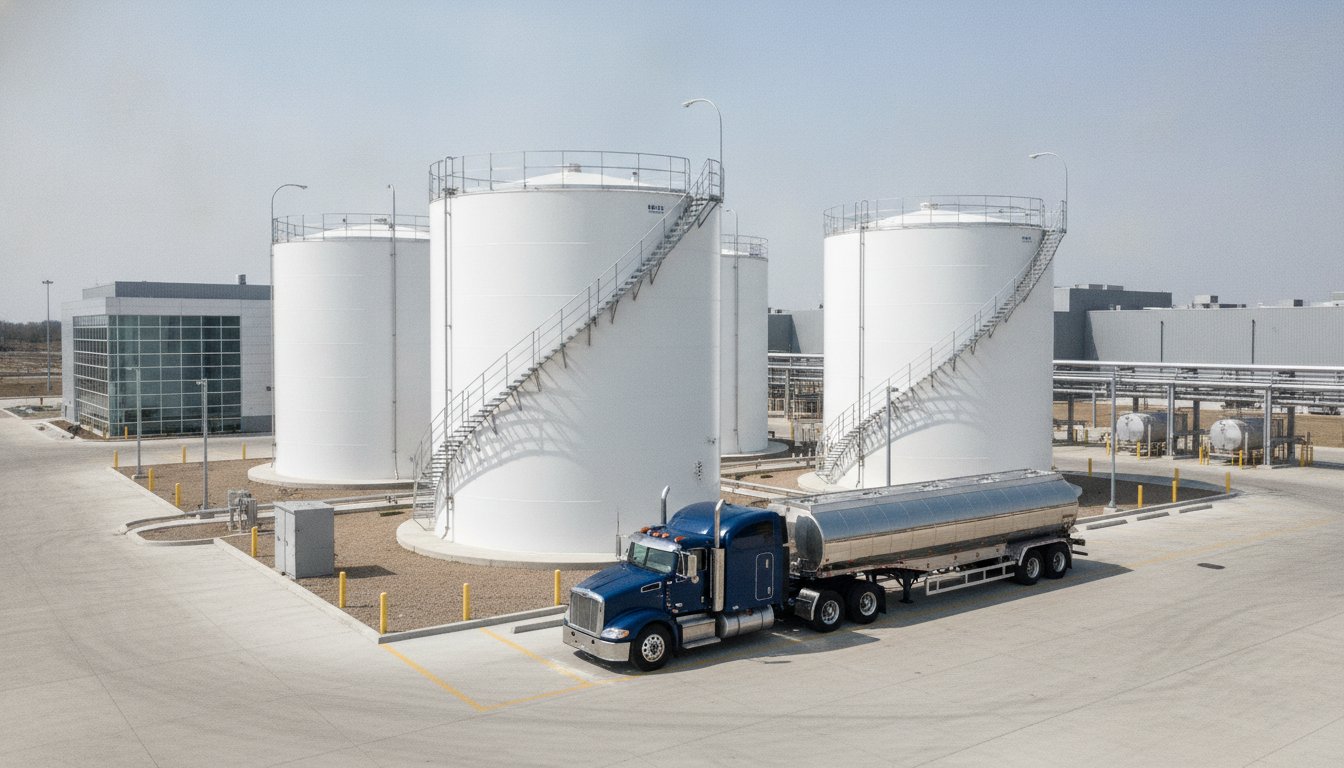
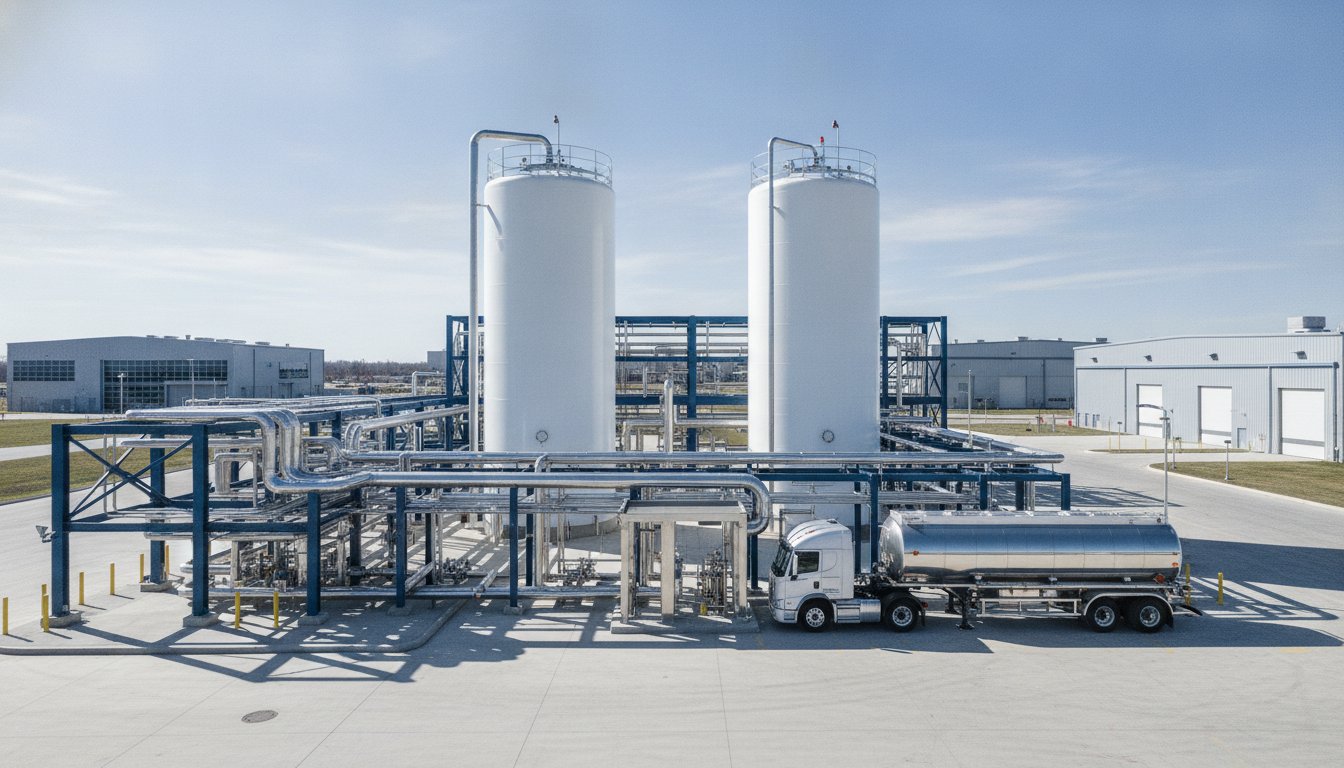
Infrastructure is the physical anchor of your fuel strategy. Deploying bulk diesel for trucking fleets requires a site-specific analysis of Aboveground Storage Tanks (AST) versus Underground Storage Tanks (UST). ASTs offer superior accessibility for maintenance and lower decommissioning costs. Conversely, USTs provide better protection from ambient temperature swings, which can impact fuel stability. Regardless of the tank type, facilities must adhere to the EPA's Spill Prevention, Control, and Countermeasure (SPCC) regulation (40 CFR Part 112). This mandate requires secondary containment and a written plan to prevent oil discharges into navigable waters. Audit your containment systems regularly to ensure they meet these industrial-scale requirements; for ongoing facility upkeep, Commercial Cleaning Services Advance Industrial Maintenance provides the professional support needed to maintain a clean and compliant site.
Integrating Automated Tank Gauging (ATG) transforms fuel into a digital asset. These systems provide inventory precision to within a fraction of an inch. When tied to cloud-based monitoring, this data allows for just-in-time delivery scheduling. This ensures you never carry excess inventory while eliminating the risk of a run-out. Precision in bulk fuel delivery logistics is achieved through this real-time visibility. It moves your operation from manual stick readings to automated, high-stakes inventory control.
Inventory Management and Cloud Monitoring
Real-time data feeds allow fleet managers to detect unauthorized usage or fuel theft immediately. By integrating tank data directly into fleet management software, you can reconcile fuel dispensed against miles driven. This level of transparency is essential for identifying engine inefficiencies or driver behavior issues. Digital tracking provides the bottom-line clarity needed for high-volume bulk diesel for trucking fleets, ensuring every gallon is accounted for and utilized for productive mileage.
Compliance and Safety Standards
High-volume storage demands strict adherence to local fire codes and National Fire Protection Association (NFPA) standards. Setback requirements and venting specifications are non-negotiable. Additionally, personnel must receive standardized training on bulk fuel transfers to mitigate the risk of overfills. This is especially relevant following the March 23, 2026, FMCSA update that removed the 95% fill limit requirement. While this change allows for greater capacity utilization, it increases the need for precise monitoring during the fueling process. Proper energy infrastructure projects must prioritize these safety protocols from the design phase through daily operation.
Analyze your current storage capacity and monitoring capabilities to identify potential vulnerabilities. Request an infrastructure and monitoring quote to upgrade your site's fuel security.
Gina Cavalier, VP Strategic Fuel Supply
Phone: 818-922-4583
Email: [email protected]
David Mor, Corporate Buyer (Spanish-speaking procurement)
Phone: +1 626-277-9795
Email: [email protected]
Fax: (866) 551-6541
Access current pricing information at login.securesupplies.us. Visit us at securesupplies.us.
Comprehensive Fleet Energy Programs by Secure Supplies Group
Managing energy for a national logistics network requires more than simple delivery. It demands a unified architecture that addresses fuel, additives, and infrastructure simultaneously. Secure Supplies Group acts as a strategic guardian, designing customized procurement strategies that scale alongside your operation. By consolidating your Ultra-Low Sulfur Diesel (ULSD) and Diesel Exhaust Fluid (DEF) requirements, you eliminate the friction of managing multiple regional vendors. This integrated approach ensures that your bulk diesel for trucking fleets is always supported by the necessary emission-control fluids and infrastructure required for 2026 compliance standards.
Energy isn't just a cost. It's a requirement for survival. Beyond standard delivery, our team manages energy infrastructure projects for new and expanding logistics hubs. From the initial site analysis to the installation of monitored tank systems, we handle the technical details of industrial energy supply. This allows your team to focus on core operations while we secure the backbone of your fleet's daily functions. We provide the foresight needed to maintain continuity in a volatile market.
A Unified Approach to Fleet Fueling
Modern engines equipped with Selective Catalytic Reduction (SCR) systems cannot operate without high-quality DEF. Treating fuel and DEF as separate logistics streams is an inefficiency your margins can't afford. Our trucking fleet fuel programs integrate these two mission-critical fluids into a single supply chain. This consolidation simplifies logistics and ensures that your AdBlue supply meets the ISO 22241 purity standards necessary to prevent dosing system failures. For fleets looking toward the future, we offer strategic consulting on the transition to CNG / LNG Programs, providing a roadmap for energy diversification and long-term sustainability.
Securing Your Supply Chain Today
Transparency is the foundation of a professional procurement relationship. We provide direct access to our procurement portals, giving you real-time visibility into current market pricing and delivery status. The onboarding process for multi-site industrial fuel contracts is streamlined to prevent operational gaps. You'll work with a dedicated account manager who understands the minute details of your regional terminal access and delivery windows. This ensures that your high-volume bulk diesel for trucking fleets is managed with the precision and authority your infrastructure demands.
Gina Cavalier, VP Strategic Fuel Supply
Phone: 818-922-4583
Email: [email protected]
David Mor, Corporate Buyer (Spanish-speaking procurement)
Phone: +1 626-277-9795
Email: [email protected]
Fax: (866) 551-6541
Access current pricing information at login.securesupplies.us. Visit us at securesupplies.us.
Securing Your Operational Future Through Strategic Energy Architecture
Achieving national fleet resilience requires a shift from reactive purchasing to a mission-critical energy strategy. You've seen how integrating ASTM D975 quality standards and real-time monitoring eliminates the vulnerabilities of retail-dependent fueling. By centralizing your procurement, you secure your margins against market volatility while ensuring full compliance with EPA and DOT regulations. Implementing a professional program for bulk diesel for trucking fleets is the final step in protecting your infrastructure from industrial downtime. To complement your operational upgrades with a professional corporate image, visit SwagStore.NET for premium custom-branded merchandise.
Secure Supplies Group provides the seasoned authority needed to manage these complex supply chains. From data center backup power to national trucking networks, we deliver the foresight and redundancy required for high-stakes operations. Under the strategic leadership of Gina Cavalier, VP Strategic Fuel Supply, we offer comprehensive energy infrastructure project management that spans the entire country. Don't leave your fuel security to chance. We're ready to stabilize your logistics today.
David Mor, Corporate Buyer (Spanish-speaking procurement)
Phone: +1 626-277-9795
Email: [email protected]
Fax: (866) 551-6541
Access current pricing information at login.securesupplies.us. Visit us at securesupplies.us.
Frequently Asked Questions
How much can a trucking fleet save by switching to bulk diesel?
Switching to bulk procurement eliminates retail markups and station operating overhead. National average retail diesel prices reached $4.83 per gallon in June 2026; bulk buyers bypass these retail margins by purchasing at wholesale spot or fixed rates. You also reduce "hidden" costs like out-of-route mileage and driver downtime at public stations. These logistical efficiencies directly improve your long-term operational margins.
What are the federal EPA requirements for on-site diesel storage tanks?
On-site storage is primarily governed by the EPA Spill Prevention, Control, and Countermeasure (SPCC) regulation under 40 CFR Part 112. Requirements include secondary containment, regular integrity testing, and a formal written spill prevention plan. Facilities must implement these measures to prevent any oil discharge into navigable waters. Compliance is mandatory for any facility with a total aboveground storage capacity exceeding 1,320 gallons.
Does bulk diesel delivery include Diesel Exhaust Fluid (DEF)?
Yes, comprehensive energy programs for bulk diesel for trucking fleets typically integrate bulk DEF / AdBlue supply. Consolidating these fluids into a single logistics stream simplifies procurement and ensures your Selective Catalytic Reduction (SCR) systems remain operational. Secure Supplies Group provides ISO 22241 compliant Diesel Exhaust Fluid alongside ULSD to maintain your fleet's emissions compliance and engine health.
How do I ensure fuel quality is maintained in large on-site tanks?
Maintaining fuel integrity requires strict adherence to ASTM D975-24 standards and proactive tank maintenance. Implement regular filtration and fuel polishing protocols to remove water and particulates. Water is the primary driver of microbial growth and injector wear. Consistent monitoring and the use of biocides prevent the accumulation of acidic sludge that can destroy high-pressure fuel injection systems.
What is the difference between clear diesel and dyed diesel for fleets?
Clear diesel is for on-highway use and includes all applicable federal and state excise taxes. Dyed diesel is tax-exempt and intended strictly for off-road equipment or stationary power generation. Using dyed fuel in on-highway bulk diesel for trucking fleets is a violation of DOT and IRS regulations. Clear diesel must meet the 15 ppm sulfur limit to comply with EPA emissions standards for modern engines.
Can a bulk fuel provider handle nationwide delivery for multi-site operations?
Strategic fuel providers manage nationwide delivery for multi-site operations through a redundant network of terminal allocations. This logistics architecture ensures that fuel remains available even during regional supply disruptions. Secure Supplies Group utilizes this multi-source approach to maintain operational continuity across various geographic hubs. We coordinate multi-state logistics to provide a single point of accountability for your entire national network.
What is an SPCC plan and why does my fleet need one for bulk fuel?
An SPCC plan is a mandatory document that outlines your facility's procedures for oil spill prevention and response. It's required by the EPA to ensure that industrial sites have adequate containment and countermeasure protocols in place. Your fleet needs this plan to maintain regulatory compliance and protect against environmental liability. Failure to maintain a current SPCC plan can result in significant federal penalties and operational shutdowns.
How does real-time tank monitoring prevent fuel shrinkage?
Automated tank gauging (ATG) provides digital transparency by reconciling fuel dispensed against your current inventory in real time. This system detects leaks, unauthorized dispensing, or delivery shortages that manual stick readings often miss. Digital tracking identifies "hidden" losses immediately, allowing for rapid intervention. Integrating this data into your fleet management software ensures every gallon is accounted for and utilized for productive drive time.
Gina Cavalier, VP Strategic Fuel Supply
Phone: 818-922-4583
Email: [email protected]
David Mor, Corporate Buyer (Spanish-speaking procurement)
Phone: +1 626-277-9795
Email: [email protected]
Fax: (866) 551-6541
Access current pricing information at login.securesupplies.us. Visit us at securesupplies.us.
Disclaimer
The information provided in this article is for general informational purposes only and does not constitute professional, legal, safety, or financial advice. Fuel and energy product specifications, pricing, availability, and regulatory requirements vary by location, application, and over time, and may differ from the general information presented here. Secure Supplies makes no warranties regarding the accuracy, completeness, or current applicability of this content. Handling, storage, and use of fuels and industrial gases can be hazardous and should always follow applicable laws, manufacturer guidance, and qualified professional advice. For current specifications, pricing, and tailored supply solutions, please contact Secure Supplies directly.