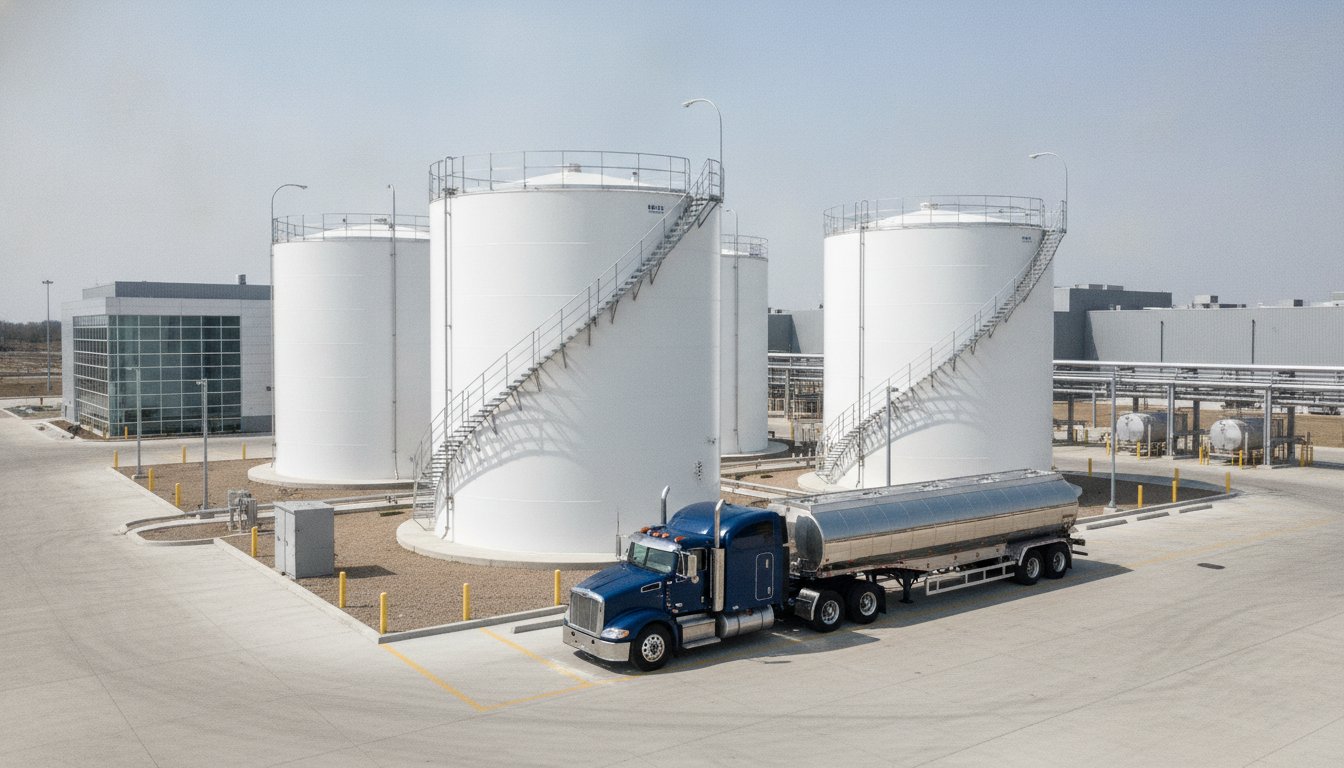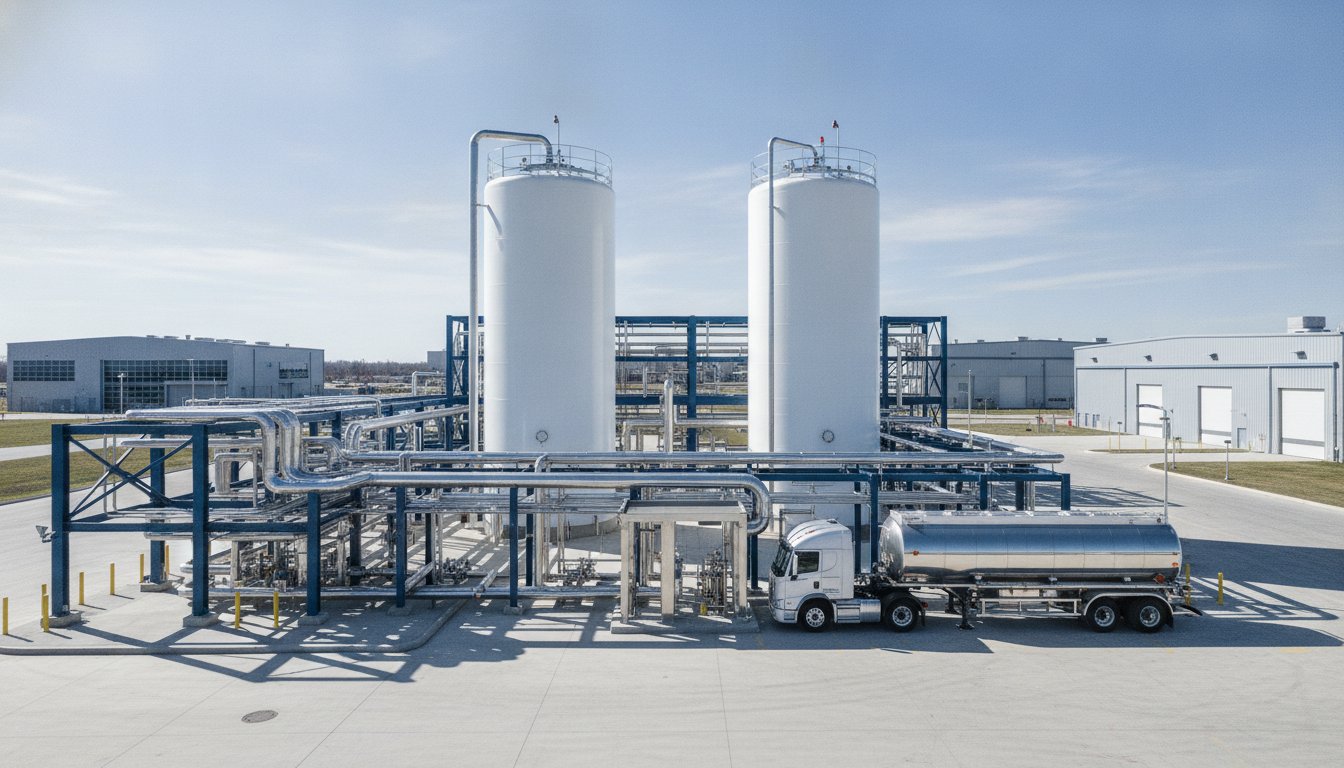

In early 2026, the national average for diesel has surged compared to the previous year, creating a volatile landscape for facility directors. These fluctuations aren't just operational expenses; they represent a mission-critical risk to the backbone of the digital economy. Relying on a just-in-time refueling model is no longer a viable strategy for infrastructure that demands total continuity. Strategic bulk fuel delivery for data centers has become the primary defense against grid instability and regional shortages that leave unprepared sites vulnerable to catastrophic downtime.
You understand that generator failure isn't an option and that priority status during a crisis is often a hollow promise without a contracted, national partner. This guide provides a strategic blueprint to ensure 100% uptime through high-volume procurement, rigorous storage integrity, and emergency logistics designed for Tier III and IV certifications. We'll analyze the shift toward private strategic fuel reserves and how to maintain compliance as states implement new regulatory frameworks for large energy consumers. You'll gain the tactical insights needed to transition from reactive purchasing to a sophisticated energy security architecture.
Key Takeaways
- Identify the critical distinctions between standard commercial fueling and the mission-critical logistics required to bridge the "last mile" during regional grid failures.
- Mitigate the degradation cycle of ultra-low sulfur diesel by implementing storage protocols that meet ASTM D975 standards for long-term fuel integrity.
- Evaluate Service Level Agreements to distinguish between "best effort" delivery and guaranteed response bulk fuel delivery for data centers during national supply shortages.
- Develop a multi-tiered redundancy plan that maps your fuel supply chain from the terminal to the generator day tank to support scalable operations.
- Secure documented compliance for Tier IV certification by integrating a strategic blueprint for high-volume procurement and emergency energy logistics.
The Infrastructure Gap: Why Standard Fuel Delivery Fails Data Centers
Standard fuel delivery is a basic commodity service. Mission-critical energy logistics is a comprehensive security architecture. Most facilities treat fuel as a simple line item until the grid goes dark. This oversight creates a dangerous infrastructure gap that threatens operational continuity. For Tier III and Tier IV facilities, maintaining 100% uptime requires more than just a full tank; it requires a resilient supply chain capable of navigating the "last mile" when roads are blocked or regional power is out. Local vendors often lack the heavy-duty equipment or priority access to terminals during large-scale disasters. This makes them a single point of failure for national operators. Given the critical role of data centers in supporting global digital infrastructure, an unreliable fuel partner is an unacceptable risk.
The High Cost of Backup Power Failure
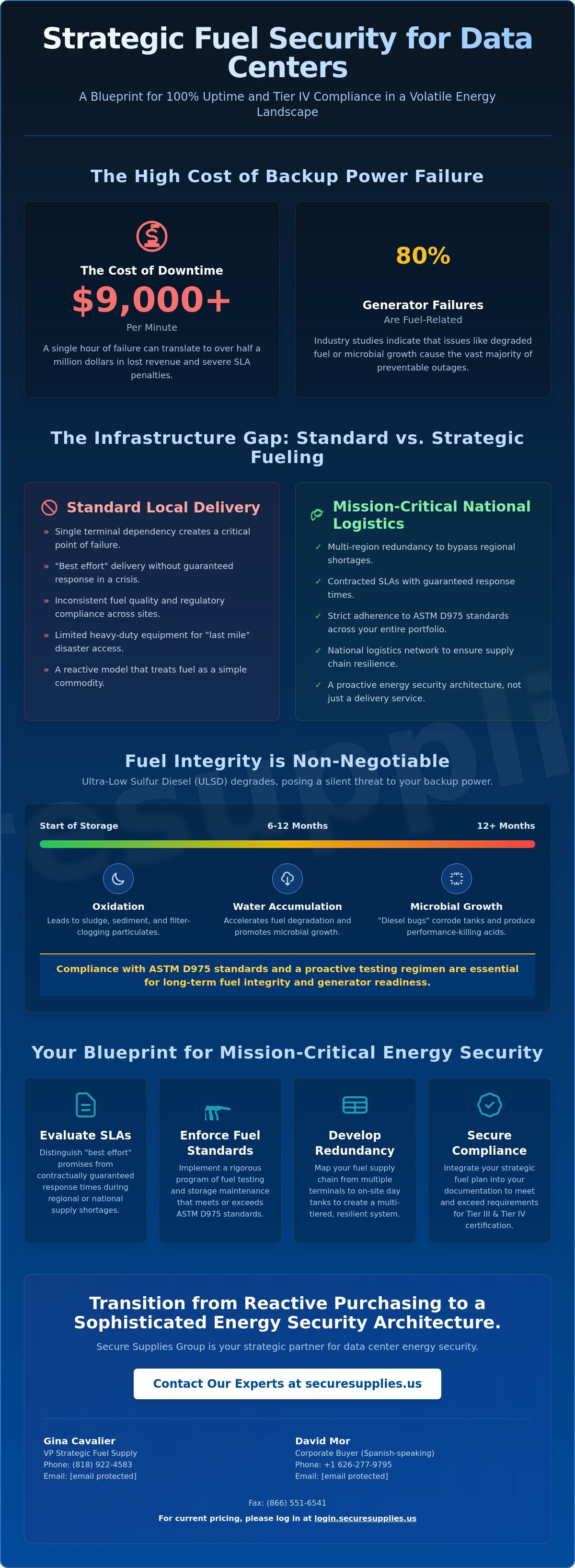
Downtime costs for modern data centers can exceed $9,000 per minute. A single hour of failure can translate to over half a million dollars in lost revenue and severe SLA penalties. Most of these outages are preventable. Industry studies indicate that fuel-related issues are responsible for a significant majority of generator failures, with some reports citing figures as high as 80%. Degraded fuel or microbial growth can clog filters at the exact moment the engine requires maximum flow. It's a proactive strategy that emphasizes on-site reserves and bulk fuel delivery for data centers that incorporates regular testing and storage integrity management. Operators are shifting from "just-in-time" models to "just-in-case" procurement to ensure they're prepared for multi-day outages.
National Scale vs. Regional Limitations
Local distributors are frequently tied to a single terminal. If that terminal loses power or runs low on inventory, the distributor's entire operation stops. A national logistics partner provides a strategic backbone that spans multiple regions. This level of redundancy allows fuel to be diverted from unaffected areas during wide-area emergencies. It also ensures that fuel specifications remain consistent across a multi-site portfolio. Whether a site is located in California or Illinois, the fuel must meet strict ASTM D975 standards to ensure generator health. A national provider manages these technical requirements and regulatory compliance details, removing the complexity of managing disparate local vendors. This approach secures the supply chain against regional volatility and ensures that mission-critical infrastructure remains online regardless of local conditions.
Fuel Integrity and Storage: Maintaining Diesel Quality for Multi-Day Outages
Ultra-low sulfur diesel (ULSD) is not a "set and forget" asset. It begins to degrade within six to twelve months under standard storage conditions. Securing bulk fuel delivery for data centers involves more than just filling a tank; it requires managing the chemical life cycle of the fuel to ensure generator readiness. Modern diesel formulations are susceptible to oxidation, water accumulation, and microbial infestation. These factors lead to sludge formation and clogged filters, which are the primary causes of engine failure during a utility outage. Adhering to ASTM D975 standards is the baseline requirement for any mission-critical facility. This specification defines the physical and chemical properties necessary for diesel fuel to perform reliably in high-output standby generators.
Monitor tank bottoms for water accumulation regularly. Water provides the medium for "diesel bugs" or microbial colonies to thrive at the fuel-water interface. These organisms produce acidic byproducts that corrode tank walls and degrade fuel quality. Implement a proactive testing regimen that includes visual inspections and laboratory analysis for particulates and water content. Reliability depends on a clean, stable supply that can sit dormant for months but perform instantly under load.
The Chemistry of Reliable Backup Power
Biodiesel blends, frequently found in standard commercial supplies, present significant risks for long-term storage. These blends are hygroscopic, meaning they actively pull moisture from the atmosphere, which accelerates the degradation process. Oxidative stability refers to the fuel's resistance to chemical breakdown caused by reaction with oxygen over time, preventing the formation of gums and sediments that clog critical engine components. High-stakes environments require fuel with high oxidative stability to survive extended standby periods. Additionally, use seasonal additives to prevent "waxing" or gelling during winter months. Cold flow improvers ensure the fuel remains liquid and filterable when temperatures drop below the cloud point.
Fuel Polishing and Maintenance Logistics
Integrate fuel polishing into your recurring maintenance schedule to remove contaminants without wasting the fuel itself. This process circulates the diesel through a multi-stage filtration system to remove water, sediment, and microbial growth. Establish a clear testing protocol based on your risk profile:
- Annual Testing: Minimum requirement for Tier II facilities to check for basic stability and contamination.
- Semi-Annual Testing: Recommended for Tier III and IV data centers to ensure peak integrity.
- Post-Delivery Testing: Verify that new fuel meets specifications before it mixes with your existing reserve.
Strategic bulk fuel delivery for data centers must account for the logistical integration of these maintenance services. Coordinating delivery with Fuel Polishing Services: Maintaining Data Center Integrity ensures your backup energy supply remains in a constant state of readiness. Consider consolidating these requirements under comprehensive Data Center Energy Programs to streamline vendor management and documentation. Documented fuel quality is a core requirement for Tier IV certification and provides the data-driven confidence needed to manage multi-site energy infrastructure.
Evaluating Service Level Agreements (SLAs): Beyond Delivery Windows
Contractual language often dictates operational survival during a regional energy crisis. Many vendors offer "best effort" delivery, which provides no legal recourse when supply chains tighten. For Tier III and Tier IV facilities, this ambiguity is a critical vulnerability. Secure bulk fuel delivery for data centers requires a "guaranteed response" contract. This agreement must specify priority status, ensuring your facility receives fuel before non-critical commercial customers during national shortages or force majeure events. Verify that your provider maintains direct terminal access and a transparent chain of custody. Documented fuel sourcing is essential for maintaining insurance coverage and meeting rigorous liability requirements in high-stakes environments.
Transparency extends to environmental and regulatory documentation. In 2026, data centers face increased scrutiny regarding grid impact and carbon footprints. Ensure your SLA includes detailed reporting for EPA compliance and ESG audits. This data must be accurate, verifiable, and delivered within your specified reporting cycles. Reliability is not a vague promise; it's a contractually obligated performance metric.
Critical SLA Performance Metrics
Response time windows are the most vital component of a mission-critical SLA. These typically range from 2-hour to 12-hour windows. Shorter windows carry higher cost implications but are necessary for sites with limited on-site storage or high burn rates. Your agreement should also define guaranteed fuel volumes. Knowing your provider has reserved specific quantities for your site prevents "allocation" issues when regional supplies drop. Include clear penalties for non-performance to align the vendor's financial incentives with your uptime requirements. This level of detail transforms a vendor relationship into a strategic partnership.
Audit Questions for Your Fuel Distributor
Perform a rigorous audit before finalizing any procurement contract. Ask specific questions about the vendor’s logistical depth. How many secondary supply terminals does the vendor have access to? Relying on a single rack is a recipe for failure if that terminal goes offline. What is the vendor’s redundancy plan if their primary fleet is grounded due to weather or mechanical failure? A robust partner will have sub-contractor agreements or a national fleet to pull from. Use this Evaluating Diesel Fuel Distributors: A Reliability Checklist to vet potential partners against industry-leading standards. These questions reveal the difference between a local truck operator and a sophisticated energy logistics architect. Ensuring bulk fuel delivery for data centers means verifying every link in the supply chain before an emergency occurs.
Strategic Fueling Programs: Designing for Redundancy and Scalability
Reactive fuel procurement is a significant liability for high-density data center campuses. A robust energy strategy maps every link in the supply chain, from the primary terminal rack to the generator day tank. This architectural approach ensures that bulk fuel delivery for data centers is not just a transaction but a continuous, resilient flow of power. As sites scale to meet 2026 demand, energy infrastructure must account for rapid expansion without compromising redundancy. Operators must navigate a shifting US regulatory environment, including the suspension of data center tax incentives in states like Illinois and the establishment of "very large customer class" definitions in Minnesota. These domestic policy shifts necessitate a scalable energy partner capable of adapting to new cost structures and higher volume requirements without service interruptions.
Step-by-Step Resilience Planning
Operational security begins with a site-specific fuel consumption audit. Calculate the burn rate at peak load to determine the exact window of autonomy provided by on-site storage. Once the baseline is established, follow these steps to harden your supply chain:
- Step 1: Consumption Audit. Quantify fuel requirements for 48-hour, 72-hour, and 96-hour runtimes under full critical load.
- Step 2: Route Redundancy. Identify and document secondary and tertiary supply routes to bypass infrastructure bottlenecks or road closures during regional emergencies.
- Step 3: Remote Monitoring. Deploy IoT-enabled tank telemetry for real-time inventory visibility. This eliminates manual dipping errors and triggers automated replenishment before reserves reach critical levels.
Integrating DEF and Industrial Gases
Compliance with EPA Tier 4 emission standards requires a reliable supply of Diesel Exhaust Fluid (DEF). Managing DEF in small quantities is inefficient and increases the risk of contamination. Bulk DEF delivery ensures your selective catalytic reduction (SCR) systems remain operational without the logistical burden of handling individual totes. Scaling facilities also require specialized industrial gases. Nitrogen and helium play critical roles in advanced cooling systems and fire suppression architectures. Consolidating the procurement of bulk fuel delivery for data centers with industrial gas requirements creates a streamlined intake process. This logistical efficiency reduces vendor sprawl and ensures that all mission-critical consumables are managed under a single, authoritative framework. Secure your infrastructure by viewing energy as a holistic system rather than a collection of separate parts. Learn more about our comprehensive Data Center Energy Programs to optimize your facility's operational resilience.
Secure Supplies Group: Your Strategic Partner for Data Center Energy Security
Reliability in energy infrastructure is the product of meticulous planning and a national logistics backbone. Secure Supplies Group operates as a strategic guardian for Tier III and Tier IV facilities, moving beyond the role of a standard vendor to become an integrated energy partner. Led by Gina Cavalier, VP of Strategic Fuel Supply, our team specializes in the high-stakes requirements of bulk fuel delivery for data centers. We understand that failure isn't an option when mission-critical data is on the line. Our approach combines national scale with the local precision necessary to navigate regional grid failures and natural disasters that often paralyze smaller distributors.
Our expertise isn't limited to liquid fuels. We manage complex energy infrastructure projects, including CNG/LNG programs and the supply of essential industrial gases like nitrogen and helium. By consolidating these requirements, facility directors reduce vendor complexity and improve operational efficiency. This integrated model is designed to exceed industry uptime requirements and provide the documented compliance necessary for Tier IV certification. We act as a logistics architect, seeing the big picture of your energy supply while managing the minute details of delivery and ASTM compliance.
The Secure Supplies Advantage
Our network provides access to a diversified array of national fuel terminals. This redundancy is essential for maintaining supply during terminal outages or regional shortages. We manage customized fueling programs for multi-site portfolios, ensuring that every location meets the same rigorous standards for fuel purity and regulatory compliance. From ASTM-certified diesel to bulk DEF supply, we maintain a high-purity supply chain that protects your generators and your uptime. This national reach ensures that even if one region faces a supply shock, your operations remain shielded through our diversified procurement channels.
Securing Your Supply Chain Today
Transitioning from a reactive to a proactive energy posture begins with a strategic fuel audit. Our team evaluates your current storage capacity, burn rates, and supply route vulnerabilities to identify potential points of failure. Onboarding with a partner that understands the gravity of industrial downtime ensures your facility is prioritized when regional resources are constrained. We provide comprehensive project management for energy infrastructure, coordinating everything from initial procurement to long-term storage integrity. Secure your mission-critical fuel supply with Secure Supplies Group and establish the energy security your facility requires.
For current pricing and to manage your account, please log in at login.securesupplies.us.
Contact our Strategic Supply Team:
Gina Cavalier, VP Strategic Fuel Supply
Phone: 818-922-4583
Email: [email protected]
Spanish-Speaking Procurement:
David Mor, Corporate Buyer
Phone: +1 626-277-9795
Email: [email protected]
Fax: (866) 551-6541
Website: securesupplies.us
Hardening Your Energy Infrastructure for 2026
The digital economy requires more than just backup power; it demands a resilient, documented energy supply chain. Securing bulk fuel delivery for data centers is a strategic commitment to 100% uptime through rigorous ASTM D975 testing and guaranteed response SLAs. Transitioning to on-site strategic reserves and national redundancy ensures your facility remains operational during grid-scale emergencies or regional shortages. By prioritizing fuel integrity and scalable logistics, you protect your infrastructure from the high cost of downtime and evolving regulatory levies. Secure Supplies Group provides the national supply chain redundancy and specialized energy programs necessary for Tier III and Tier IV facilities. Our dedicated mission-critical response teams act as your logistics architect, managing every detail from terminal access to storage maintenance. Take the next step in securing your facility's future and ensuring operational continuity.
Request a Strategic Fuel Logistics Consultation
Contact our Strategic Supply Team:
Gina Cavalier, VP Strategic Fuel Supply (818-922-4583, [email protected])
David Mor, Corporate Buyer for the Spanish-speaking Secure Supplies Group (+1 626-277-9795, [email protected])
Fax: (866) 551-6541
For current pricing, please log in at login.securesupplies.us.
Frequently Asked Questions
What is the standard response time for emergency fuel delivery to data centers?
Standard response times are dictated by your specific Service Level Agreement (SLA). These windows are typically categorized into 2-hour, 4-hour, or 12-hour response tiers. The selection depends on your on-site storage capacity and the critical nature of your load. Tier III and IV facilities usually require the shortest windows to mitigate risk during extended outages. Ensure your contract guarantees these times during regional emergencies when local resources are constrained.
How long can diesel fuel be stored before it becomes unreliable for generators?
Diesel fuel stability is limited to approximately 6 to 12 months under ideal conditions. Ultra-low sulfur diesel is chemically unstable and prone to oxidation and sediment formation over time. Environmental factors like condensation and temperature changes can shorten this window. Regular testing is essential to determine if the fuel still meets ASTM D975 standards for reliable generator ignition and sustained operation.
Does my data center need fuel polishing if I use ultra-low sulfur diesel?
Yes, fuel polishing is a requirement for maintaining storage integrity. ULSD is hygroscopic and attracts water, which creates an environment for microbial growth. This "diesel bug" creates sludge that clogs filters and causes engine failure. Strategic bulk fuel delivery for data centers includes scheduled polishing to remove these contaminants. This process restores the fuel to its optimal chemical state without the need for total replacement.
What are the EPA requirements for bulk diesel storage at data centers in 2026?
The EPA mandates compliance with Spill Prevention, Control, and Countermeasure (SPCC) regulations for facilities with large storage capacities. You must implement secondary containment, regular integrity testing, and precise record-keeping. In 2026, there's also a focus on managing the environmental impact of emissions, making the supply of Diesel Exhaust Fluid (DEF) critical for Tier 4 compliance. Documented spill response plans are a non-negotiable part of these requirements.
How does a national fuel distributor handle local supply disruptions during a disaster?
National distributors utilize a diversified network of supply terminals to bypass local infrastructure failures. If a primary terminal loses power or runs low on inventory, the distributor pulls fuel from a secondary or tertiary rack in an unaffected region. This logistics backbone ensures that bulk fuel delivery for data centers remains consistent even during wide-area disasters. Local vendors often lack the fleet scale and terminal access to provide this level of redundancy.
Can Secure Supplies Group manage both diesel and DEF delivery for my fleet?
Secure Supplies Group manages the delivery of both bulk diesel and Diesel Exhaust Fluid (DEF). Modern Tier 4 generators require DEF to meet emission standards, and an empty DEF tank can trigger engine derating or shutdown. Consolidating these deliveries streamlines your procurement process and ensures that all mission-critical fluids are managed by a single, authoritative partner. This integrated approach improves operational efficiency and simplifies vendor management.
What documentation is required for Tier IV data center fuel compliance?
Tier IV certification requires rigorous documentation of every component in the energy supply chain. You must provide ASTM D975 certificates of analysis, proof of a 12-hour or better response SLA, and detailed maintenance logs for fuel polishing. Compliance also involves documenting the chain of custody from the terminal to the site. These records prove that your energy infrastructure is capable of supporting the "fault-tolerant" requirements of a Tier IV environment.
Is it better to have underground or above-ground bulk fuel storage for uptime?
Above-ground storage tanks (ASTs) are the industry standard for data centers because they allow for immediate visual inspection and easier maintenance. While underground tanks offer better protection from fire or extreme weather, they are susceptible to undetected leaks and ground-water contamination. ASTs facilitate more effective fuel polishing and water removal. For most facilities, the accessibility and lower environmental risk of above-ground storage outweigh the benefits of burying the tanks.
Disclaimer
The information provided in this article is for general informational purposes only and does not constitute professional, legal, safety, or financial advice. Fuel and energy product specifications, pricing, availability, and regulatory requirements vary by location, application, and over time, and may differ from the general information presented here. Secure Supplies makes no warranties regarding the accuracy, completeness, or current applicability of this content. Handling, storage, and use of fuels and industrial gases can be hazardous and should always follow applicable laws, manufacturer guidance, and qualified professional advice. For current specifications, pricing, and tailored supply solutions, please contact Secure Supplies directly.